Last updated 2026-08-18
TL;DR
Connecticut has no single state-issued "soft wash license," but you will almost certainly need a Home Improvement Contractor registration, a business entity filing, a pesticide applicator certificate if you use algaecides, and general liability insurance. Most new operators are ready to take paying jobs within 4 to 10 weeks of starting paperwork.
Do you need a license for soft wash in Connecticut?
No single "soft wash license" exists in Connecticut. What the state runs instead is a layered system of registrations and certificates that apply depending on what you wash, what chemicals you spray, and whether you take money for the work.
The foundation for almost every operator is registration as a Home Improvement Contractor (HIC) with the Connecticut Department of Consumer Protection (DCP). Connecticut General Statutes Section 20-417a through 20-417o define home improvement to include cleaning, repair, and restoration services performed on a residential property. Soft wash a house, collect a fee, and you are performing home improvement under that definition. You need the registration. [9]
The registration fee has run in the $220 range for a two-year term, but fees change. Confirm the current amount with DCP. You also provide proof of general liability insurance and post a $15,000 surety bond as part of the application. [1]
Chemical choice creates a second fork. Apply sodium hypochlorite alone and that typically does not trigger pesticide licensing in Connecticut. Add a biocide formulated to kill or slow the growth of algae, mold, or mildew, and if that biocide is an EPA-registered pesticide product, Connecticut may classify you as a pesticide applicator. The Connecticut Department of Energy and Environmental Protection (DEEP) oversees pesticide licensing, and any operator using registered pesticide products commercially is expected to hold the appropriate applicator certification under CGS Section 22a-54. [2]
The pesticide applicator exam through DEEP covers pest identification, safety, and application methods. DEEP sets the exam fee and renewal schedule. Confirm current costs and categories with the DEEP Pesticide Management Program before you sit for the exam. [2]
One more layer. If you operate as any entity other than a sole proprietor using your legal name, you register that entity with the Connecticut Secretary of the State. An LLC filing runs around $120 in recent years, but confirm the current fee with the Secretary of the State. [3]
What business registrations does Connecticut require before you take a job?
Three parallel tracks all have to close before you invoice anyone. Think of it that way and nothing sneaks up on you.
Track one is your business entity. File your LLC or corporation with the Connecticut Secretary of the State online. Processing is often same-day for online filings. If you are a sole proprietor operating under a trade name, you file a trade name certificate at the town clerk's office where your principal office sits. Town clerk fees vary but usually run under $25. [3]
Track two is your Home Improvement Contractor registration. Apply through DCP. The application asks for your business name, address, entity type, insurance certificate, and surety bond documentation. Allow a few weeks for processing. HIC registrations run on a two-year cycle. [1]
Track three is sales tax. Connecticut imposes a 6.35 percent sales and use tax, and the Department of Revenue Services (DRS) has issued guidance that cleaning services, including exterior cleaning of residential and commercial property, can be taxable depending on the specific service. You need a Sales Tax Permit (also called a Connecticut Tax Registration Number) from DRS before you collect any money. Registration is free and done online at myconnect.ct.gov. [4]
Hire any W-2 employees and you also register as an employer with DRS and the Connecticut Department of Labor, which runs the unemployment insurance system. That is a separate registration from your sales tax permit.
None of these tracks are optional. Running without a HIC registration in Connecticut carries civil penalties up to $1,000 per violation under CGS Section 20-427. [8]
What insurance does a Connecticut soft wash operator need?
The HIC registration requires proof of general liability insurance as a condition of approval. Connecticut law does not set a single mandated minimum dollar amount for HIC general liability in the statute, but DCP expects a certificate of insurance, and many carriers and commercial customers want to see at least $1 million per occurrence and $2 million aggregate. Larger commercial accounts regularly ask for $2 million per occurrence. [1]
Beyond what DCP needs to issue the registration, your real insurance needs track your exposure. Soft wash chemicals damage landscaping, stain trim, and harm surfaces when applied wrong. A standard general liability policy covers bodily injury and property damage to third parties, but ask your agent directly about chemical coverage and pollution exclusions. Many base GL policies exclude pollution events, and bleach landing where it should not can get classified as a pollutant under some policy language. A pollution liability endorsement or a standalone contractor's pollution liability policy closes that gap.
Commercial auto insurance is required in Connecticut for any vehicle used in business operations. Personal auto policies typically exclude commercial use. Your truck or van carries chemicals to jobs, so it needs a commercial auto policy. [5]
Workers' compensation is required the moment you hire any employee in Connecticut, including part-time workers. Connecticut General Statutes Section 31-284 makes workers' comp mandatory for employers. [6]
The $15,000 surety bond required for HIC registration is not insurance. The bond protects customers if you fail to finish a contracted job or violate the home improvement statutes. Shop bond rates separately. For a $15,000 bond, premiums typically run $100 to $200 per year depending on your credit score, though rates vary by surety company.
Do Connecticut soft wash operators need a pesticide license?
Most new operators get this one wrong. The answer hinges on exactly what goes in the tank.
Sodium hypochlorite (bleach) is not classified as a pesticide under EPA or Connecticut DEEP rules when used for cleaning. Mix bleach, water, and a surfactant and put it on a roof or siding, and that is not a pesticide application in the regulatory sense.
The line moves when you add an EPA-registered pesticide product, meaning a product that carries an EPA Registration Number on its label and is labeled for killing or preventing algae, mold, lichen, or similar organisms. Plenty of commercial soft wash surfactants and additives carry EPA registration numbers precisely because they make pesticidal claims. If the label says the product kills algae, it is probably a registered pesticide, and applying it commercially requires a Connecticut pesticide applicator license. [2]
Connecticut DEEP requires commercial pesticide applicators to pass a General Standards exam plus at least one category exam relevant to their work. Exterior cleaning work typically falls under Category 9 (wood preservation or ornamental pest control) or an adjacent category. Check with DEEP directly for the current category list that fits your specific services. [10]
Here is the practical route to stay clearly outside the pesticide licensing system: use only unregistered cleaning chemicals and make no pesticidal claims about your work. Want to use registered biocide products? Budget the time to get the applicator certificate first.
What equipment does a Connecticut soft wash startup actually need?
Soft wash differs from pressure washing because the cleaning chemical does most of the work. Pressure at the nozzle stays under 500 PSI in most soft wash protocols, which means the pump matters less than the chemical delivery and metering system.
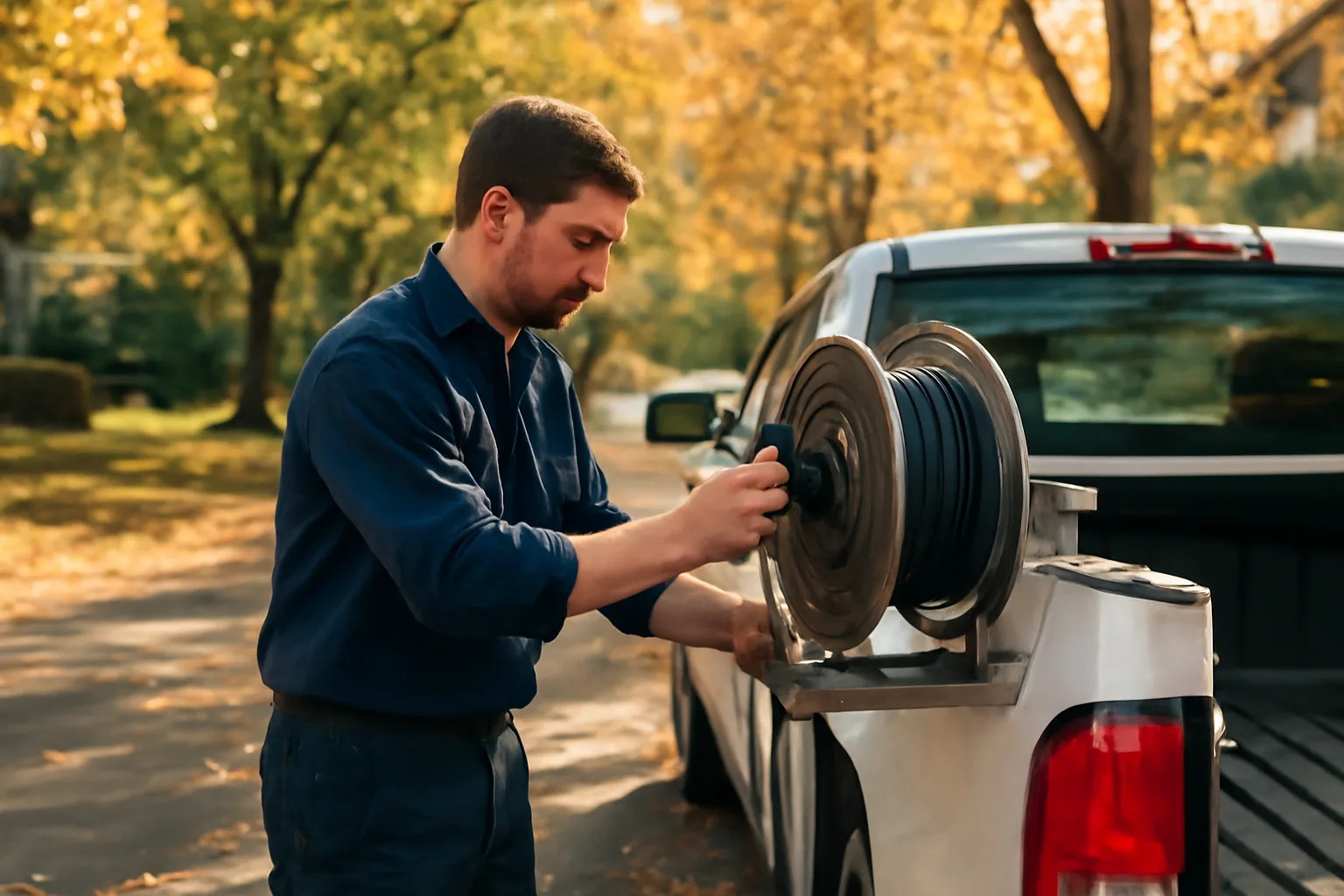
A workable entry-level setup includes a 12-volt pump system or a dedicated low-pressure soft wash pump, a 100 to 250 gallon mix tank, downstream or upstream injection equipment, a reel with 200 to 300 feet of hose, and a set of soft wash nozzles sized for different applications. A functional but not fancy rig runs roughly $2,500 to $6,000 depending on pump brand and tank size. Mounting it in a used pickup bed or on a trailer adds to that range.
Connecticut's climate matters here. Winters are real. You need a winterization plan for your equipment, and if you do not want to stop working in cold months, a heated enclosed trailer solves that problem at added cost.
For chemical storage, Connecticut DEEP has rules about storing hazardous materials on commercial vehicles and at residential properties used as business storage. Sodium hypochlorite in bulk quantities may require specific secondary containment and labeling. Check with DEEP's materials management programs before you park 250 gallons of 12.5 percent SH in your garage. [2]
Want to round out your chemical knowledge before the first job? The SoftWashPath Chem + Dwell + Insurance Kit at $149 covers dilution ratios, dwell time protocols, and the specific insurance language new operators should request from their agent.
How much does soft wash cost in Connecticut?
Pricing in Connecticut runs higher than the national average for exterior services. Higher labor costs drive it, along with longer travel times from suburban sprawl and an affluent residential market where customers expect quality and push back less on price.
For a standard residential house wash (exterior siding on a 1,500 to 2,500 square foot home), Connecticut operators typically charge between $250 and $500. Larger or two-story homes move toward $400 to $700. These ranges reflect what operators in the Connecticut market actually advertise. Nobody has authoritative statewide survey data on this, and local variation is real. Shoreline towns like Westport, Greenwich, and Madison support higher pricing than inland markets.
Roof cleaning runs separately and commands a premium. A typical single-family roof treatment (not a wash, just algae treatment) in Connecticut runs $300 to $700 depending on pitch, square footage, and access. Metal or slate roofs with complex geometry cost more.
Driveway and concrete soft wash treatments (where you pre-treat with a low-pressure chemical application before rinsing) run roughly $0.15 to $0.30 per square foot depending on contamination level.
On the cost side, chemical cost per house wash is genuinely low. A standard diluted SH mix for a 2,000 square foot house might use 5 to 10 gallons of working solution depending on surface porosity and contamination level. At current bulk SH prices (which fluctuate; pool supply and janitorial distributors in Connecticut are the best source), your chemical cost per job often runs under $15 to $30. That is one reason gross margins on soft wash look attractive.
Here is a rough breakdown of typical Connecticut pricing by service type:
| Service | Typical Price Range (CT) |
|---|---|
| House wash (1,500-2,500 sq ft) | $250 to $500 |
| House wash (2,500-4,000 sq ft) | $400 to $700 |
| Roof algae treatment | $300 to $700 |
| Driveway/concrete soft wash | $0.15 to $0.30 per sq ft |
| Deck soft wash and treatment | $150 to $400 |
| Commercial building exterior | $500 to $2,000+ |
How long does soft wash take in Connecticut?
Two questions live inside this one: how long the work takes on-site, and how long it takes to get fully legal and operational.
On-site, a standard house wash on a 2,000 square foot colonial takes one experienced operator roughly 1.5 to 2.5 hours from truck to truck. That includes setup, chemical application, dwell time, rinse, and cleanup. Add a partner and you cut that to under 90 minutes on most jobs. Roof treatments take similar time but often need more careful positioning and a longer dwell before rinsing or leaving to weather off.
Getting the business operational is a different clock. Here is a realistic timeline:
Entity formation: 1 to 3 business days (online LLC filing with the Secretary of the State).
Sales tax registration: same day to 2 business days (online through DRS).
Surety bond: 1 to 3 business days once you apply with a bonding company.
Insurance certificate: 1 to 5 business days depending on your agent and how fast they bind a policy.
HIC registration: DCP processing times vary and can run 2 to 6 weeks in busier periods. This is usually the longest step. Confirm current processing times with DCP before you set a launch date.
Pesticide applicator certificate (if needed): exam scheduling varies by season and DEEP testing availability. Budget 4 to 8 weeks if you need this credential.
Start all tracks at once and a new operator can be fully legal and insured in 4 to 10 weeks, with the HIC registration setting the pace. Do not advertise residential jobs until the HIC registration is in hand.
How do Connecticut environmental rules affect soft wash operations?
Connecticut has real environmental rules that shape how and where you discharge runoff from soft wash jobs.
Connecticut DEEP administers the state's water quality program, and runoff containing chemicals, including diluted sodium hypochlorite, detergents, and biocides, cannot flow into storm drains, wetlands, or water bodies. Connecticut General Statutes Section 22a-427 and the state's General Permit for the Discharge of Stormwater from Small Municipal Separate Storm Sewer Systems (MS4) program set the framework. [7]
What this means in practice: think about where your rinse water goes. On most residential jobs, rinsing across a lawn where the water soaks into the ground is generally acceptable. Rinsing directly into a driveway drain that connects to a storm sewer is not acceptable without added control measures. On commercial jobs near any waterway or wetland setback, expectations get stricter.
Connecticut also has some of the most protective inland wetlands regulations in the country, administered at the municipal level by local Inland Wetlands and Watercourses agencies. Working on a property near a wetland or watercourse? Your customer is responsible for any permits, but you should know what sits near your work area.
DEEP's pesticide management program also sets rules for disposing of pesticide containers and handling any unused pesticide mix. These apply if you are licensed as a pesticide applicator. [2]
None of this should scare you off. Most residential soft wash jobs create no environmental compliance issue if you use normal professional practices. Knowing the rules before a complaint gets filed beats learning them after.
What does a Connecticut soft wash operator's first year actually look like financially?
Nobody has reliable aggregate data on first-year Connecticut soft wash revenues. What follows is built from publicly available cost inputs, not a guarantee.
Startup costs for a lean but legal first-year operation in Connecticut might look like this:
Equipment (basic soft wash rig): $3,000 to $6,000 Vehicle (used truck or van, if you do not already have one): $8,000 to $20,000 HIC registration and bond: $350 to $450 LLC filing: around $120 General liability insurance (annual): $1,500 to $3,000 depending on coverage limits and claims history Commercial auto insurance (annual): $1,800 to $4,000 Pesticide applicator exam and license (if needed): $100 to $300 in fees Marketing (Google Business Profile is free; simple website and basic ads): $500 to $2,000 first year
Total first-year overhead before a single job: somewhere between $15,000 and $35,000, driven heavily by whether you need a vehicle and what insurance rates you qualify for.
On the revenue side, an operator completing 3 to 5 jobs per week at an average ticket of $350 generates $54,600 to $91,000 in annual gross revenue on a full season. Connecticut's soft wash season runs roughly April through November, with cold weather limiting outdoor chemical application in winter. An eight-month working season at that pace is realistic for a part-time or part-season operator ramping up.
Gross margins on completed jobs often land at 60 to 75 percent before your labor, vehicle, and overhead allocation. Net margins in year one, after all real costs including your own time, come out much thinner. Year two is generally where the model gets comfortable.
How do you market a new soft wash business in Connecticut?
Connecticut has a dense suburban population, most of it homeowners with older housing stock that genuinely needs exterior cleaning. The marketing environment gets competitive in Fairfield County but stays thinner in Hartford County and the northeast corner of the state, where fewer operators have staked out territory.
Your Google Business Profile is the single most important marketing asset you can build, and it costs nothing. A completed profile with accurate service areas, photos of actual work, and real customer reviews puts you in the map pack for local searches like "soft wash Connecticut" and "house washing" in your target towns. Fill out every field.
For operators targeting the high-income shoreline market (Fairfield County, New London County waterfront towns), before-and-after photos hit hard on social media, particularly Instagram and Nextdoor. Nextdoor is unusually effective for exterior cleaning because it is neighborhood-specific and customers explicitly trust recommendations from neighbors.
Direct mail to targeted ZIP codes still works in Connecticut. A postcard mailing to owner-occupied homes in specific towns costs roughly $0.35 to $0.55 per piece including design and postage at current rates. A 1,000-piece saturation mailing to a target town runs $350 to $550 and typically generates a 1 to 3 percent response rate, which at a $350 average ticket produces $3,500 to $10,500 in potential revenue from a single drop.
Do not skip commercial accounts. Connecticut has a heavy concentration of HOA communities, commercial property management companies, and institutional facilities (universities, hospitals, corporate campuses) that outsource exterior maintenance. These accounts close slower but produce predictable recurring revenue.
For other state comparisons and startup frameworks, the how to start soft wash in California and how to start soft wash in Colorado guides cover states with similarly high regulatory bars and show patterns that apply across markets.
What are the most common mistakes Connecticut soft wash operators make in year one?
Operating before the HIC registration is in hand is the single most common and costly mistake. Some operators start taking jobs while waiting on DCP processing, treating the paperwork as bureaucratic formality. It is not. Operating without the registration is a civil violation under Connecticut law and can bring fines, and it also voids your insurance in many cases because the policy was written assuming lawful operation. Wait for the card. [8]
Underpricing is the second most common error. New operators look at what pressure washing companies charge and undercut them to win jobs. Soft wash is a premium service with better results on most surfaces. Price it that way. Customers who shop on price alone are not your best customers anyway.
Ignoring the pesticide question is third. Mix in a product with an EPA registration number and a pesticidal claim, do it commercially without a license, and you are in violation of state pesticide law. The enforcement risk is real because DEEP does investigate complaints. Either get the license or keep your chemical mix clearly outside the registered pesticide category.
Skipping commercial auto coverage because "it's just my personal truck" is fourth. A chemical spill, an accident on the way to a job, or a vehicle theft while equipment sits in the truck can all produce claims that a personal auto policy refuses to pay. The commercial endorsement or standalone commercial policy is not optional.
The SoftWashPath Chem + Dwell + Insurance Kit was built to help new operators avoid the insurance language mistakes. At $149 it is the lowest-cost way to see what your GL policy should say and what it probably does not cover by default.
For comparison with how other states handle these same questions, see how to start soft wash in Alaska and how to start soft wash in Arizona, where the regulatory posture differs meaningfully from Connecticut.
Frequently asked questions
Do you need a license for soft wash in Connecticut?
You need a Home Improvement Contractor (HIC) registration from the Connecticut Department of Consumer Protection to clean residential properties for pay. There is no dedicated "soft wash license." If you apply EPA-registered pesticidal products commercially, you also need a Connecticut pesticide applicator certificate from DEEP. An LLC or trade name filing with the Secretary of the State is required if you operate under a business name.
How much does soft wash cost in Connecticut?
Connecticut operators typically charge $250 to $500 for a standard house wash on a 1,500 to 2,500 square foot home. Roof algae treatments run $300 to $700. Concrete and driveway work prices at roughly $0.15 to $0.30 per square foot. Fairfield County and shoreline towns support the upper end of those ranges. These figures reflect market-level pricing, not a regulated rate.
How long does soft wash take in Connecticut?
On-site, a standard house wash takes one operator about 1.5 to 2.5 hours. Getting fully legal takes longer: LLC filing is usually 1 to 3 days, insurance 1 to 5 days, but HIC registration from DCP can take 2 to 6 weeks. If you need a pesticide applicator certificate, add another 4 to 8 weeks for exam scheduling. Most operators are fully operational within 4 to 10 weeks of starting the process.
What is the Home Improvement Contractor registration in Connecticut and how do I apply?
The HIC registration is issued by the Connecticut Department of Consumer Protection and is required for anyone performing paid home improvement services, including exterior cleaning, on residential property. You apply through DCP, submit proof of general liability insurance, and post a $15,000 surety bond. The registration is valid for two years. Confirm current fees and processing times directly with DCP, as both change periodically.
Does sodium hypochlorite use require a pesticide license in Connecticut?
Using plain sodium hypochlorite (bleach) mixed with water and a surfactant does not require a pesticide license in Connecticut because bleach is not an EPA-registered pesticide. The license requirement triggers when you apply a product that carries an EPA Registration Number and makes pesticidal claims, such as killing algae or mold. If your mix stays to unregistered cleaning chemicals, you stay outside the pesticide licensing system.
What kind of insurance does a Connecticut soft wash business need?
You need general liability insurance (at minimum $1 million per occurrence is standard practice), a commercial auto policy for your work vehicle, and workers' compensation once you have any employees. Ask your agent specifically about pollution exclusions, because many base GL policies exclude chemical incidents. A pollution liability endorsement covers the gap that bleach overspray or runoff could create. The HIC registration requires proof of GL insurance.
What environmental rules apply to soft wash runoff in Connecticut?
Chemical-laden runoff cannot be discharged into storm drains, wetlands, or watercourses under Connecticut DEEP rules and CGS Section 22a-427. On most residential jobs, rinsing across a lawn where water infiltrates the soil is acceptable. Near water bodies, wetlands, or commercial storm drains, you need additional controls. Connecticut's inland wetlands regulations are administered at the town level, so know what is near your work area.
How much does it cost to start a soft wash business in Connecticut?
A lean but legal first-year setup in Connecticut typically runs $15,000 to $35,000 total, depending heavily on whether you need a vehicle. Equipment alone costs $3,000 to $6,000. Add $1,500 to $3,000 for GL insurance annually, $1,800 to $4,000 for commercial auto, roughly $450 for the HIC registration and bond, and $120 for an LLC filing. These are estimates; confirm current fees with each agency.
Do I need a sales tax permit in Connecticut for soft wash services?
Yes. Connecticut imposes a 6.35 percent sales and use tax, and the Department of Revenue Services has indicated that exterior property cleaning services can be taxable. You need a Connecticut Tax Registration Number from DRS before you collect any payment. Registration is free and done online at myconnect.ct.gov. Operate without it and you risk back-tax liability plus penalties.
Can I run a soft wash business from home in Connecticut?
Yes, many operators do. You will need to check your town's zoning rules for home-based businesses, particularly for chemical storage and commercial vehicle parking. Some municipalities restrict which chemicals and what quantities can be stored residentially. Connecticut DEEP also has requirements around secondary containment for bulk chemical storage. Register your business address with DCP as your HIC address regardless of whether it is home-based.
How do I find customers for soft wash in Connecticut?
Google Business Profile is the highest-return free tool available. Complete every field, add real photos, and request reviews from every satisfied customer. Nextdoor is unusually effective for exterior cleaning in Connecticut suburbs. Direct mail to targeted ZIP codes generates 1 to 3 percent response rates at $0.35 to $0.55 per piece. For recurring revenue, target HOA communities and commercial property managers who control multiple properties.
What penalties apply for operating without a HIC registration in Connecticut?
Connecticut General Statutes Section 20-427 allows civil penalties up to $1,000 per violation for operating without a Home Improvement Contractor registration. Beyond the fine, contracts made without the registration can be voidable by the customer, meaning they could potentially recover money paid. Insurance coverage may also be compromised if a claim arises while the business was operating unlicensed.
Is a surety bond the same as insurance for Connecticut soft wash businesses?
No. The $15,000 surety bond required for HIC registration protects your customers if you fail to complete a job or violate home improvement law. It does not protect you or cover third-party property damage. General liability insurance protects against damage claims, bodily injury, and related suits. Both are required for HIC registration; they serve entirely different purposes.
When is the best season to launch a soft wash business in Connecticut?
Late February through March is the ideal launch window for paperwork so that you are fully legal by April, when exterior cleaning demand picks up as homeowners come out of winter. The working season runs roughly April through November in Connecticut. Launching in summer means competing for jobs while still closing compliance gaps. Starting legal paperwork in winter gives you the longest runway into peak season.
Sources
- Connecticut Department of Consumer Protection, Home Improvement Contractor Registration: HIC registration is required for paid home improvement services on residential property in Connecticut, including cleaning; requires GL insurance and a $15,000 surety bond
- Connecticut DEEP, Pesticide Management Program: Commercial applicators using EPA-registered pesticide products in Connecticut must hold a pesticide applicator certificate; DEEP administers the exam and licensing program
- Connecticut Secretary of the State, Business Services Division: LLC formation and trade name registration for Connecticut businesses are administered by the Secretary of the State; LLC filing fee applies
- Connecticut Department of Revenue Services, Sales and Use Tax: Connecticut imposes a 6.35 percent sales and use tax; cleaning services on real property can be taxable; a tax registration number is required before collecting payment
- Connecticut Insurance Department: Vehicles used for commercial business operations in Connecticut require commercial auto insurance; personal auto policies typically exclude commercial use
- Connecticut Workers' Compensation Commission: Connecticut law makes workers' compensation insurance mandatory for all employers including those with part-time workers; CGS Section 31-284 establishes the requirement
- Connecticut DEEP, Stormwater General Permits: Connecticut DEEP administers stormwater discharge rules under CGS 22a-427; chemical runoff from cleaning operations cannot be discharged to storm drains or watercourses
- Connecticut Department of Consumer Protection, Home Improvement Act: CGS Section 20-427 imposes civil penalties up to $1,000 per violation for operating as a home improvement contractor without a valid registration
- Connecticut Department of Consumer Protection, Home Improvement Act (Sections 20-417a through 20-417o): Connecticut Home Improvement Act defines home improvement to include cleaning and restoration services on residential property, establishing the scope of HIC registration requirements
- Connecticut DEEP, Pesticide Management Program, Applicator Licensing: CGS Section 22a-54 requires commercial pesticide applicators in Connecticut to hold a certificate issued by DEEP before applying EPA-registered pesticide products; category exams required