Last updated 2026-08-18
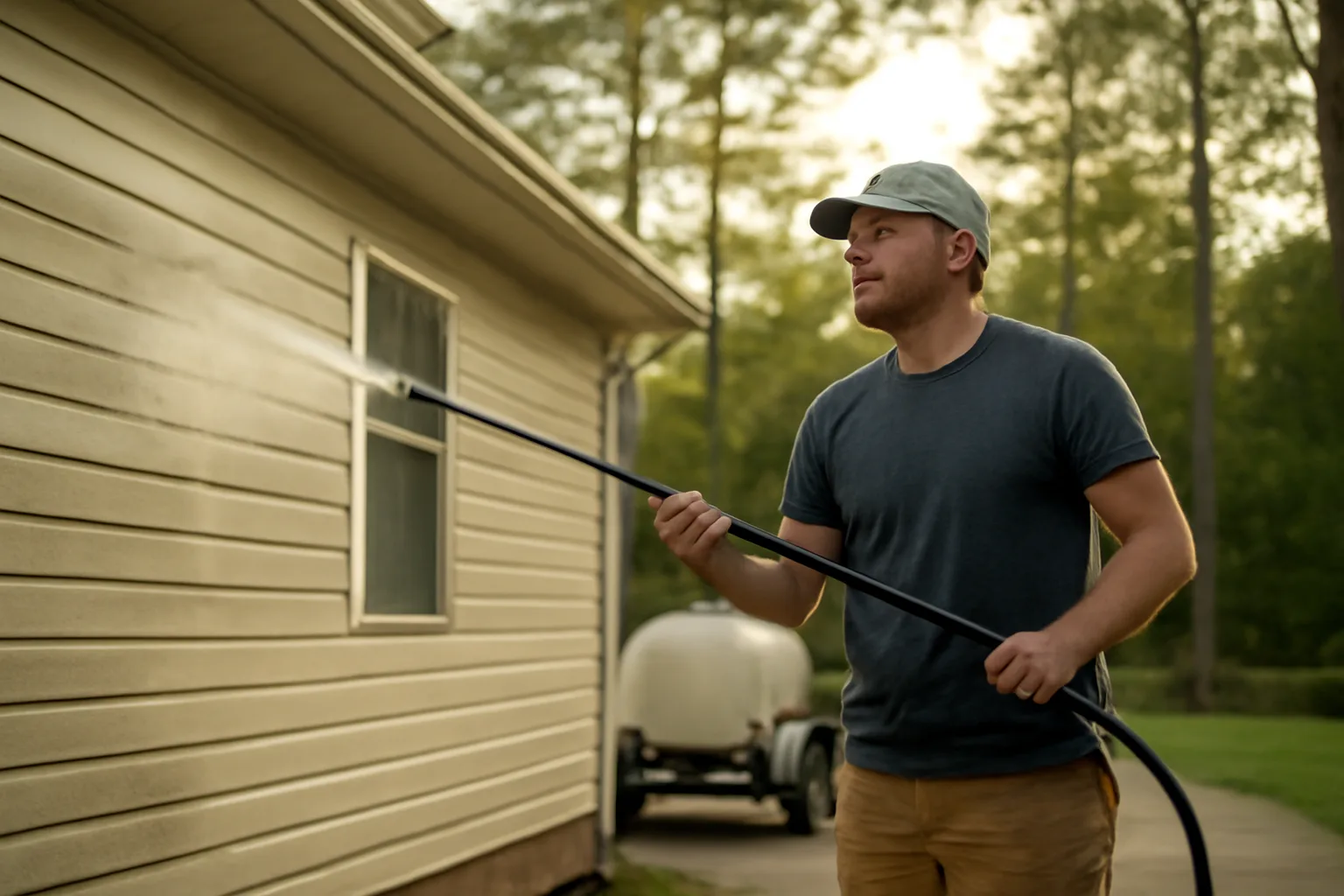
TL;DR
Georgia soft wash businesses that use bleach need a commercial pesticide applicator license from the Georgia Department of Agriculture. That license renews every five years ($90 as of 2024) plus 10 CEUs. Your LLC also files an annual registration with the Secretary of State ($50 by April 1). No state-level soft wash license exists. There is no single soft wash renewal, just these two or three separate filings.
do you need a license for soft wash in georgia?
Yes, in most cases. Georgia doesn't issue a “soft wash” license. But the moment you apply a chemical that counts as a pesticide, you need a commercial pesticide applicator license from the Georgia Department of Agriculture [1]. The EPA classifies sodium hypochlorite (bleach) as an antimicrobial pesticide, and bleach is in almost every soft wash mix. The Georgia Pesticide Control Act (O.C.G.A. § 2-7-50) defines “pesticide” broadly enough to cover the agents you use for mold, mildew, or algae [2].
This isn't paperwork theater. The Department can issue stop-work orders and fines for unlicensed applications. New operators get caught off guard by it all the time.
One detail people miss: the license goes to the individual applicator, not the business. If you're the owner spraying chemicals, you need it. Hire someone to spray, and they need one too.
There are two license types you'll hear about. The Commercial Pesticide Applicator license covers the person doing the work. The Pesticide Contractor license covers the business entity that advertises and contracts for pesticide work. The Georgia Department of Agriculture states that “a commercial pesticide applicator license is valid for a period of five years” [1]. The contractor license runs on the same clock.
Use only water and no chemicals, and you may skip the pesticide license entirely. But plain-water pressure washing rarely gets the result homeowners picture when they say soft wash. Most mixes carry bleach, surfactants, and sometimes algaecides. So you're almost certainly in the pesticide category.
Local business licenses are a separate animal. Many Georgia cities and counties want a general business license or occupational tax certificate. That's a local call. The state doesn't touch it.
what do you actually renew for georgia soft wash and when?
The renewal that matters most is your commercial pesticide applicator license. It expires five years from the issue date, and the Department sends no reminder. You track it or you lose it. Renewal itself is simple: submit the application, pay the fee, show your continuing education credits or retake the exam.
The renewal fee for a commercial pesticide applicator license is $90 as of 2024 [1]. The Pesticide Contractor license renewal runs $100. Fees move, so confirm the current schedule with the Department before you mail anything.
You need 10 CEUs across each five-year cycle, all approved by the Department. University of Georgia Extension courses, industry workshops, and approved online programs all count. Miss the deadline or fall short on credits, and your only option is retaking the certification exam. That burns time and money. Mark your calendar.
Your business entity is a different filing. An LLC or corporation files an annual registration with the Georgia Secretary of State, $50 for LLCs and $60 for corporations, due by April 1 [3]. Miss it and the state can administratively dissolve your LLC. Reinstatement means paperwork plus extra fees. File online at sos.ga.gov. It asks for the basics: name, address, registered agent, and a short description of what you do.
Got a local business license? Its schedule varies. Some cities renew annually, some every two years. Ask your city or county clerk. The cost usually lands under $100.
Here's the full renewal calendar for a Georgia soft wash business:
- Every year by April 1: LLC annual registration ($50)
- Every five years from license issue date: pesticide applicator license renewal ($90) + 10 CEUs
- Every five years from issue date: pesticide contractor license renewal ($100, if you hold one)
That's the whole list. No other state-level soft wash renewals exist.
how much does soft wash cost in georgia?
No regulation sets soft wash pricing in Georgia. The market does. A typical single-family home (1,500 to 2,500 square feet) draws quotes from $350 to $700. Bigger homes or heavy organic growth push past $1,000. Roof-only soft wash runs $200 to $500, depending on pitch and access.
Nobody has clean Georgia-specific cost data. The closest national number comes from HomeAdvisor, which puts a typical pressure-washing house job at $300 to $600 [4]. Soft wash usually runs a bit higher because of the chemical solutions and dwell time. Talking to operators, my read on the Georgia market is $0.15 to $0.30 per square foot for a house. That's not a published stat. It's what people quote.
Starting out? Don't undercut that range. Bleach, surfactant, and insurance are real line items. Georgia humidity means algae and mildew come back fast, so customers often want recurring service. Some operators sell annual contracts at a discount. That smooths your income but locks in a thinner margin.
Know your own cost structure before you price anything. SoftWashPath's $149 Chem + Dwell + Insurance Kit gives you a starting frame for chemical and insurance basics, but you still have to plug in your own labor and equipment overhead.
how long does soft wash take in georgia?
A house soft wash in Georgia takes two to four hours for a typical two-story home. That covers setup, chemical mixing, application, dwell time, low-pressure rinse, and cleanup. A roof adds another hour or two. Driveways and decks, done separately, run 30 minutes to an hour each.
Weather drives the clock more than most people expect. Georgia summer heat dries chemicals too fast. You rinse sooner, which cuts dwell time and can force a second pass. In winter, anything below 45°F slows the chemistry. You wait longer or switch your mix.
Bob Vila's guide on pressure washing times says a 2,000-square-foot house usually takes two to three hours for a thorough wash [5]. Soft wash sits in the same ballpark. Chemical application is faster than high-pressure work, but dwell time eats the difference. A good surfactant that clings to vertical surfaces shaves real time, which is a trick most Georgia operators pick up after a few humid summers.
Bidding jobs? Build in drive time. Georgia suburbs and rural routes spread out. A 30-minute drive each way adds an hour to your day. That's cost, not slack.
what local permits and business registrations do georgia cities and counties require?
Georgia has no statewide business license. Each city and county issues its own. Atlanta wants a business license through the city's Office of Revenue. Savannah routes it through the Revenue Department. Smaller cities like Macon and Athens run similar systems. The application usually asks for your state pesticide license number, proof of insurance, and a modest fee.
Some counties add a “home occupation” permit if you run the business from your house. That's common in Gwinnett, Cobb, and Fulton. The permit runs $50 to $150 and can trigger a zoning review.
Renewal for local licenses is usually annual. You'll get a notice, but treat it as a bonus, not a system. Keep a spreadsheet. Operating without a local license invites fines and, in some places, a property lien. I've never seen a soft wash operator shut down purely over a missing city license, but it's a dumb risk to carry.
Work across several cities and you may need a license in each. A few offer reciprocity if you're licensed at the county level. Most don't. Call the city clerk before you take work there.
where do you get your 10 ceus for pesticide applicator continuing education?
The Georgia Department of Agriculture requires 10 CEUs per five-year license cycle, earned in categories that match your license. Soft wash operators usually land in “Ornamental and Turf” or “General Pest Control.” The Georgia Structural Pest Control Commission handles some pest categories, but for exterior soft wash the Department's Pesticide Division is the primary authority.
You can earn CEUs through:
- University of Georgia Extension workshops (often free or low cost)
- Georgia Pest Control Association events
- Online courses from approved providers
Most operators find it easiest to attend a one-day workshop that covers all 10 hours. UGA Extension posts a schedule each year, and the cost usually lands under $100. Hold onto your certificates of completion. At renewal, you submit copies with your application.
Short on CEUs? You can retake the commercial pesticide applicator exam instead. The Department administers it, the fee is $45, and it covers the Core Manual plus category-specific material. Study and you'll likely pass, but the test runs a few hours and you have to schedule it. Tracking CEUs is the easier road.
One bonus: you can carry over up to 5 CEUs into the next cycle if you earned them in the final year of your license. That's a useful buffer.
what happens if you let your georgia soft wash license expire?
Let your commercial pesticide applicator license expire and you can't legally apply pesticides for hire. No soft wash jobs that use bleach. The Georgia Department of Agriculture can issue a cease-and-desist order and fine you up to $1,000 per violation [2]. Enforcement is mostly complaint-driven in practice. A customer or competitor reports you, and a letter shows up.
You get a 30-day grace period after expiration to renew without re-testing. Past 30 days, you retake the exam. Let it lapse more than a year and you may have to reapply as a brand-new applicant, paying the initial fee and sitting the exam again.
The LLC annual registration works differently. The Georgia Secretary of State gives a 60-day grace period after April 1. File late and you pay a $25 late fee. Don't file at all and the state administratively dissolves your LLC. Reinstatement means filing an application and paying all back fees plus a $310 reinstatement fee, and you have five years to do it [3]. After five years, the state releases your business name and you can't reclaim it.
Don't let anything expire. Set reminders on your phone and forget the drama.
soft wash chemicals and georgia regulations: the epa and georgia epd
The Department of Agriculture isn't the only agency watching you. The EPA has its own pesticide rules, and the label on every chemical is a legal document. If the label reads “not for use on roofs,” you cannot use it on roofs, no matter how long you've been doing it.
The Georgia Environmental Protection Division regulates wastewater discharge. Soft wash runoff that reaches storm drains or waterways can trigger a violation, so control it. Berms, diversion, and collection keep you clean. The EPD can issue fines under the Clean Water Act [7], and metro Atlanta has seen crackdowns after heavy rain.
Georgia also has protections for licensed applicators, but those don't override local ordinances. Some cities restrict chemical use near water bodies or during certain hours. Check before you spray.
insurance requirements for soft wash in georgia
No Georgia law forces a soft wash business to carry general liability insurance. But your pesticide contractor license can require proof of it. The Georgia Department of Agriculture asks for a certificate of insurance showing general liability coverage, with a minimum around $300,000 per occurrence [1].
Commercial clients, HOAs, and property managers usually want more. Many require $1 million in coverage, so you'll likely carry above the state floor. SoftWashPath's Chem + Dwell + Insurance Kit walks through insurer basics, but you still need an agent who understands the soft wash niche.
Workers' compensation is required in Georgia if you have three or more employees. Carry it even with one. Insurance costs vary. A small soft wash operation might pay $500 to $1,500 a year for general liability. That's a real number. Build it into your pricing before you quote a single job.
how to start a soft wash business in georgia: the first-year paperwork path
If you're reading this, you're probably already running jobs or about to. For the record, here's the first-year checklist:
1. Form your LLC or corporation with the Georgia Secretary of State. The LLC filing fee is $100 online. You need a registered agent in Georgia. 2. Get a Federal EIN from the IRS (free). 3. Apply for your commercial pesticide applicator license. Pass the exam first. Study the Core Manual and category material. The exam fee is $45. 4. Apply for a pesticide contractor license if your business entity will contract for the work. 5. Get a local business license in your city or county. 6. Get insurance. 7. File your annual LLC registration by April 1, every year, forever.
That's the paper path. No shortcuts. The Department of Agriculture posts the application forms. Start to finish, budget 30 to 60 days, assuming you pass the exam on the first try.
Want the rules in other states? See our guides on soft wash renewal in Florida and soft wash renewal in Alabama. Every state runs its own cycle, and the differences are bigger than you'd guess.
soft wash renewal in georgia vs. other states: a quick comparison
Georgia sits in the middle of the pack for regulatory weight. Florida makes you hold a certified pest control operator license plus a business license from DBPR, and that operator license wants a 4-year degree or equivalent experience, a 2-year renewal cycle, and 20 CEUs (see our soft wash renewal in Florida guide). Georgia's pesticide license is simpler by a wide margin.
Alabama also uses a commercial pesticide applicator license, run through the Alabama Department of Agriculture and Industries, with annual renewal and 6 CEUs (see soft wash renewal in Alabama). California puts soft wash operators under the Structural Pest Control Board, with a 3-year renewal and 30 CEUs (see soft wash renewal in California).
Georgia's 5-year cycle is a real perk. Once you have the license, you don't think about it for a long stretch. The LLC annual registration is the only yearly chore.
Don't get lazy about it, though. The Georgia Department of Agriculture audits pesticide applicators. Keep your CEU certificates, insurance documents, and renewal forms in one folder. When the renewal notice lands, act that week. A 5-year cycle is exactly long enough to make you forget.
Frequently asked questions
do you need a license for soft wash in georgia?
Yes, if you use any chemical that is a pesticide under Georgia law. Bleach (sodium hypochlorite) is an antimicrobial pesticide. You need a commercial pesticide applicator license from the Georgia Department of Agriculture. If you use only water, no license is required, but that's rare for true soft wash.
how much does soft wash cost in georgia?
A typical house soft wash in Georgia costs between $350 and $700. Roof-only jobs run $200 to $500. Larger homes or those with heavy mildew can exceed $1,000. These are market rates, not regulated prices. HomeAdvisor's national average for pressure washing a house is $300 to $600, and soft wash is often slightly higher.
how long does soft wash take in georgia?
A standard house soft wash takes two to four hours. That includes setup, chemical application, dwell time, rinse, and cleanup. Roof soft wash adds about an hour. Weather, house size, and crew experience shift the timeline. Georgia's humidity can require longer dwell times in summer.
how do i renew my pesticide applicator license in georgia?
Submit a renewal application to the Georgia Department of Agriculture before your license expires. Pay the $90 fee. Include proof of 10 CEUs earned during the 5-year licensing period. If you lack CEUs, you can retake the exam. Renewals are processed by mail, so allow 4 to 6 weeks.
what is the georgia llc renewal fee?
The annual LLC registration fee in Georgia is $50. It's due by April 1 each year. You can file online at the Georgia Secretary of State's website. A late fee of $25 applies if you miss the deadline.
is there a grace period for georgia pesticide license renewal?
Yes, there is a 30-day grace period after expiration. During that window, you can renew without retesting. After 30 days, you must retake the certification exam. After one year, you may have to reapply as a new applicant.
do i need a local business license for soft wash in georgia?
Most cities and counties in Georgia require a general business license or occupational tax certificate. You must check with your local government. Examples include Atlanta, Savannah, Macon, and Athens. Fees range from $50 to $150, and renewal is typically annual.
what ceus are accepted for georgia pesticide license renewal?
The Georgia Department of Agriculture accepts CEUs from approved providers, including University of Georgia Extension, the Georgia Pest Control Association, and accredited online courses. You need 10 CEUs per 5-year cycle. You can carry over up to 5 CEUs if earned in the final year.
can i soft wash roofs without a pesticide license in georgia?
No, not if you use chemicals to clean the roof. Most roof soft wash solutions contain bleach, which is a pesticide. The Georgia Pesticide Control Act requires a license for any pesticide application for hire. Using only water might be exempt, but that's not effective for roof cleaning.
how much does a pesticide contractor license cost in georgia?
The pesticide contractor license renewal fee is $100. It also requires a licensed commercial pesticide applicator inside the business. This license covers the business entity that advertises and contracts for pesticide work. Renewal is every 5 years.
what insurance do i need for soft wash in georgia?
Georgia requires general liability insurance for pesticide contractor licenses, typically a minimum of $300,000 per occurrence. Many clients require $1 million. Workers' comp is required if you have three or more employees. Costs range from $500 to $1,500 per year for general liability.
how do i get a pesticide applicator license in georgia?
Pass the commercial pesticide applicator exam administered by the Georgia Department of Agriculture. Study the Core Manual and category-specific material. Pay the $45 exam fee. Then apply for the license. The license is valid for 5 years.
Sources
- Georgia Department of Agriculture, Commercial Pesticide Applicator Licensing: A commercial pesticide applicator license is valid for a period of five years. The renewal fee is $90 and the license requires 10 CEUs.
- Georgia Pesticide Control Act (O.C.G.A. § 2-7-50): The Act defines pesticides and requires licensing for commercial applicators. Violations can result in fines up to $1,000 per offense.
- Georgia Secretary of State, Annual Registration Requirements: LLCs must file an annual registration with a $50 fee by April 1. Late fee is $25. Reinstatement after dissolution costs $310.
- HomeAdvisor, Cost to Pressure Wash a House: The national average cost to pressure wash a house is $300 to $600.
- Bob Vila, How Long Does It Take to Pressure Wash a House?: A 2,000-square-foot house typically takes two to three hours to pressure wash thoroughly.
- Georgia Department of Agriculture, Pesticide Contractor License: The pesticide contractor license renewal fee is $100 and requires a commercial applicator license within the business.
- Georgia Environmental Protection Division, Stormwater Discharge: The Georgia EPD regulates wastewater discharges under the Clean Water Act, including pesticide runoff entering storm drains.