Last updated 2026-08-18
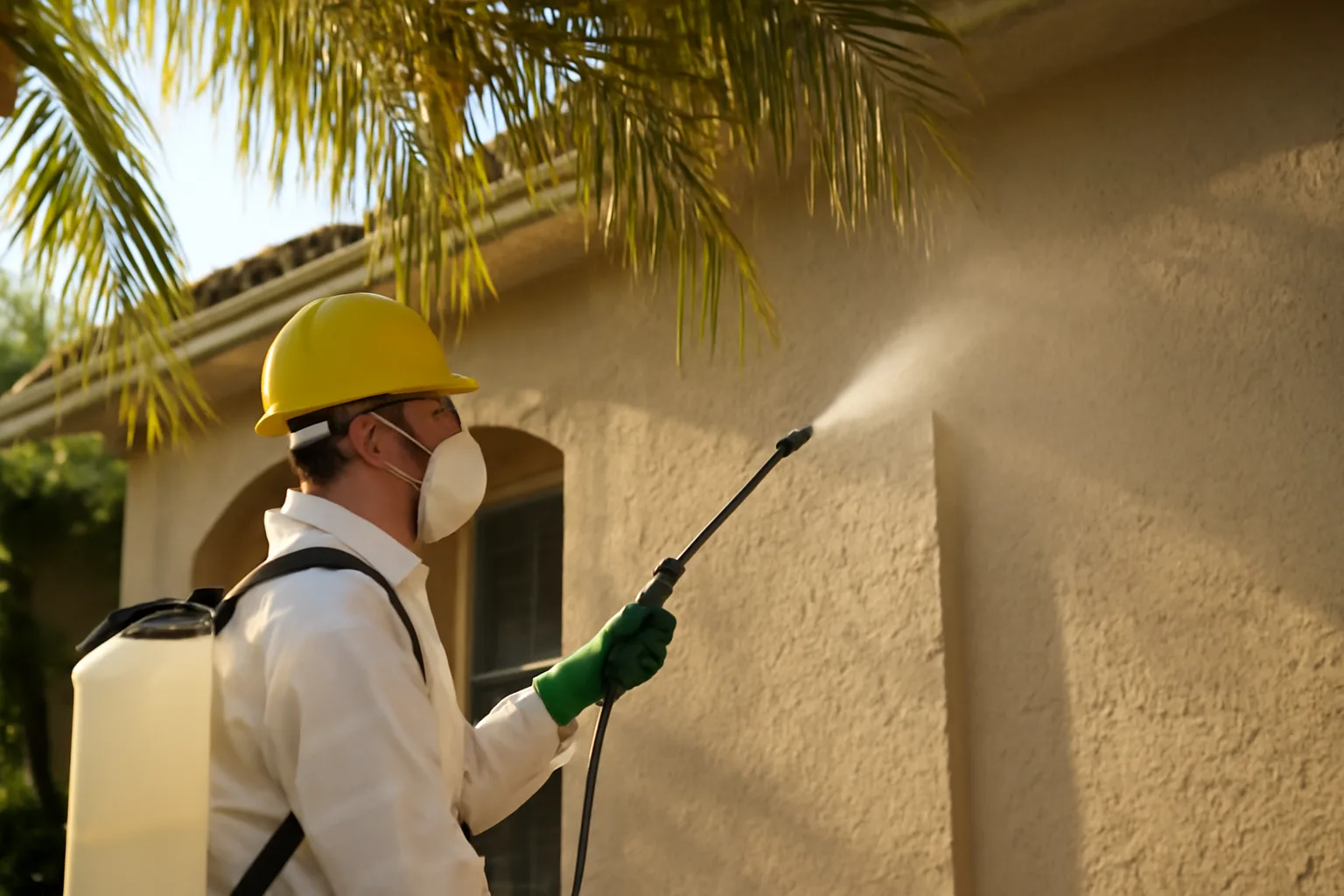
TL;DR
Florida doesn't sell a “soft wash license.” Spraying bleach to kill algae, mold, or mildew on a building for pay is pesticide application. You need a Limited Commercial Landscape Maintenance (LCLM) certification from FDACS. The exam costs $100. You also need a local business tax receipt. House washes run $250 to $500, roof cleaning $500 to $1,200, and most jobs take two to four hours.
Do you need a license for soft wash in Florida?
Yes, but not a trade license. Florida treats soft wash chemicals as pesticides the moment you use them to control living things like algae, fungi, and mildew. Chapter 482 of the Florida Statutes says “any person who for compensation uses or supervises the use of any pesticide… shall be certified” [1]. Soft wash mixes contain sodium hypochlorite, which the U.S. Environmental Protection Agency registers as a pesticide. Spray it for pay and you fall under the same rules as a pest control operator.
The credential you need is the Limited Commercial Landscape Maintenance (LCLM) certification. FDACS issues it. It lets you apply pesticides, herbicides, and algaecides to lawns, ornamentals, and structural surfaces where fungus or algae is growing. Roof, siding, paver, and stucco cleaners all work under that one cert. Skip it and you risk fines up to $5,000 per violation [2].
What is the LCLM certification and who needs it?
The LCLM is a pesticide applicator credential built for landscape maintenance work. FDACS created it for lawn care operators, but Chapter 482 defines a “pest” to include algae, moss, and fungi, so cleaning the outside of a building lands squarely inside it. Rule 5E-14.142 of the Florida Administrative Code names who must hold the LCLM: anyone making pesticide applications to lawns and ornamentals not for agricultural purposes [3]. Soft washing goes after roof algae (Gloeocapsa magma), sidewalk mildew, and pool cage mold, so the department counts you as a limited commercial applicator.
Here's the part people miss. If you employ someone who sprays, that person must be certified or work under the direct supervision of a certified applicator. If you own the company and you're the only one holding the wand, the cert has to be yours. You do not need a Certified Pest Control Operator license, a general contractor license, or a specialty structure cleaning license from DBPR. The state sees this as pesticide application, not construction [4].
How do you get the LCLM certification in Florida?
Three steps. First, register with FDACS and pay the $100 examination fee, either through the FDACS Pesticide Licensing portal online or by mailing Form DACS-13625. Second, study. The exam covers Florida pesticide law, label comprehension, safety, personal protective equipment, application equipment, environmental protection, and integrated pest management. Third, schedule and pass the exam at a county extension office or an approved testing site. Passing takes a score of 75% or better [5].
Pass, and FDACS mails a certification card good for four years. Renewal takes 4 continuing education units (CEUs) in approved pesticide topics plus a $100 renewal fee. Those CEUs can come from online courses, industry conferences, or FDACS-approved providers. Keep it current and it stays current. Let it lapse and you retest from scratch.
Where can I find study materials and exam locations for the LCLM test?
The University of Florida IFAS Extension Bookstore sells the official LCLM manuals. The core book is “Applying Pesticides Correctly” (SM 1). Many applicants also grab the Florida-specific LCLM prep guide from UF's pesticide information office. Figure $30 to $50 a book [6].
The exam runs at UF/IFAS County Extension offices statewide. Find a site on the FDACS Limited Commercial Landscape Maintenance page, which lists active county offices, phone numbers, and exam dates. Some private testing companies offer the LCLM exam too, but county offices are the simplest route. You get a pass or fail on the spot. The official card lands in the mail within two to four weeks.
What local business tax receipt and registration do Florida cities require?
On top of the LCLM cert, every soft wash business in Florida needs a local business tax receipt from the county or city where the business is based. Most cities require one even if the jobs are elsewhere. Miami-Dade County, for one, charges a Business Tax Receipt of $50 to $400 depending on the classification and headcount [7]. You register once and renew every year. There's no state-level business license just for soft washing from the Florida Department of Business and Professional Regulation, unless you also do something like general contracting.
Using a fictitious name means registering it with the Florida Department of State's Division of Corporations. That fee is $50. The name lands in the Sunbiz registry, and your bank will want it to open a business checking account. Sole proprietors using their legal name don't have to file, but a separate EIN from the IRS makes tax season cleaner.
What insurance do you need for soft washing in Florida?
Florida law doesn't force general liability insurance on soft wash work unless a contract says so. In practice, every HOA, property manager, and commercial client will ask for a certificate showing at least $1 million in general liability. Plenty of operators carry $2 million aggregate and an umbrella policy for the bigger jobs [8].
Employees change the math. If you have any, Florida requires workers' compensation insurance, even for part-timers. Section 440.10 of the Florida Statutes makes it mandatory with few exceptions. Solo owner-operators can file an exemption, but hire one helper on payroll and you need a workers' comp policy [9]. That's another $1,500 to $3,000 a year in fixed costs. Read the fine print too: some policies carve out pollution from chemical runoff, so confirm yours covers sodium hypochlorite application before you sign.
How much does soft wash cost in Florida?
A standard single-story house wash up to 2,000 square feet runs $250 to $500. Roof cleaning is priced by the foot at $0.15 to $0.25, so a 2,000-square-foot roof lands around $400 to $500, and a big home can hit $800 to $1,200. Driveway cleaning averages $150 to $300. A wooden deck soft wash averages $200 to $400. Pool cage cleaning, which fights mold and pollen hard in Florida, runs $175 to $350. Those ranges come from a UF IFAS Extension survey of Florida pressure washing and soft wash businesses [10].
Those numbers assume a standard sodium hypochlorite mix, a downstream injector, and a residential soft wash pump. Add surfactant blends, fragrance, or sealers and the price climbs 15 to 25 percent. Distance moves quotes more than people expect. Most companies tack on a fuel surcharge past a 30-mile radius.
How long does a soft wash job take in Florida?
A typical 2,000-square-foot house wash takes two to four hours, counting pre-wet, chemical application, dwell time, and rinse. Roof cleaning runs longer, four to six hours for an average roof, because the product needs more contact time and the rinse burns through more water. Pool cages, paver patios, and driveways usually take 30 to 90 minutes of active spray plus cleanup. The wild card is plant and surface protection. Florida yards are dense, so covering sensitive plants, bagging downspouts, and moving fragile stuff adds 30 to 60 minutes to nearly every job.
Dwell time matters too. Most bleach-based mixes want 10 to 15 minutes of dwell before you rinse. High humidity keeps the solution wet longer and can cut how much surfactant you need. Mid-afternoon heat does the opposite, so you bump surfactant or work in smaller sections. None of this pushes a job to eight hours. It just keeps you on site longer than a straight power wash would.
How does Florida regulate bleach use in soft washing?
The EPA classifies sodium hypochlorite (SH) as an algaecide and fungicide, so Florida treats it as a pesticide once it's applied for hire. That single fact is why the LCLM requirement exists. You can buy SH at pool supply stores, chemical distributors, or hardware stores with no license at all. The regulated act is applying it on a customer's property for money. The Florida Pesticide Law (Chapter 482) draws no line between roofs, siding, driveways, and landscaping. If the target is a pest and you're paid, the application is regulated [1].
Soft wash crews also run surfactants, which aren't regulated as pesticides, plus plant-friendly neutralizers to cut runoff. Any product whose label claims to kill or control algae, mold, or mildew is a pesticide by definition. Mix your own solution and the SH in it is still a pesticide. The label on the jug guides you, but the law watches the act of applying for hire.
Do you need a pressure washing license for soft wash in Florida?
No, not from DBPR. Pressure washing and soft washing aren't construction services. They're cleaning services, and they fall under pesticide rules the moment chemicals enter the picture. Do only water-fed high-pressure cleaning with zero chemicals and you don't need an LCLM. But plain water rarely holds up in Florida's humid, algae-hungry climate, so almost every exterior cleaning business that lasts uses SH and therefore needs the LCLM.
Some cities file exterior cleaning under “service contractor” for business tax receipt purposes, but none make you sit a state trade exam the way plumbing or electrical does. This trips up a lot of new operators. The only license the state requires for soft wash is the pesticide cert, and it comes from FDACS, not the Construction Industry Licensing Board.
How does Florida's soft wash license compare to nearby states?
Southeastern states handle this all over the map. Alabama doesn't require a pesticide license for cosmetic algae removal on structures. We break that down in our guide to the soft wash license in Alabama. California goes the other way and requires a Pest Control Business license from the Department of Pesticide Regulation for any structural pest control, soft washing included; see the soft wash license in California. Colorado treats soft wash chemicals as general-use pesticides but still requires a commercial applicator license if you advertise algae control, which we cover in the soft wash license in Colorado. Florida's LCLM sits in the middle: lighter than California, heavier than Alabama.
Expansion is where cross-state licensing gets ugly. California wants a separate exam and a qualified applicator license, laid out in how to start soft wash in California. Florida's renewal is simpler too; our soft wash renewal in California guide shows how much rougher it gets there. Florida soft wash licensing is manageable. It just isn't optional.
What are the steps to start soft washing legally in Florida?
Here's the clean order. 1) Write a business plan. 2) Register your business name with Sunbiz and get an EIN. 3) Buy the LCLM study guides from UF IFAS Extension. 4) Schedule and pass the exam at your county office and pay the $100 fee. 5) Get a local business tax receipt from your home county or city. 6) Open a business bank account. 7) Buy general liability insurance that covers pesticide application, at least $1 million. 8) Buy equipment: a 12V or diaphragm pump, a chemical tank, hose, and a gun. 9) Dial in your downstream mix ratios for roof, house, and concrete. 10) Start marketing to HOAs and property managers.
Track your CEUs from day one. Four units have to land inside each four-year cycle. Many equipment distributors and chemical suppliers run free or cheap CEU courses. The FDACS online portal lets you log credits and upload certificates as you go.
Once your cert and insurance are in hand, clients will ask for proof. SoftWashPath's $149 Chem + Dwell + Insurance Kit bundles a certificate template, a sample COI, and a dwell time guide to move your paperwork faster. It's at /start.
Frequently asked questions
Do I need a license to soft wash my own house in Florida?
No. The LCLM certification only applies when you're applying pesticides for compensation. Homeowners cleaning their own roof or siding with bleach are exempt. You still have to follow label directions and keep the runoff out of storm drains.
Can I use an employee without an LCLM certification to spray chemicals?
No. Anyone who applies pesticides for your business must hold a valid LCLM certification or work under the direct supervision of a certified applicator. Direct supervision means the certified person is on site, more than reachable by phone.
What is the fine for soft washing without an LCLM in Florida?
FDACS can issue a stop-work order and fine up to $5,000 per violation for unlicensed pesticide application. Repeat offenses carry higher penalties, and the department can refer cases for criminal prosecution if negligence causes environmental harm.
How long does it take to get the LCLM certification?
From the day you register to the day the card is in your hand usually runs four to eight weeks. Study at your own pace, exam dates open monthly at most extension offices, and the card arrives two to four weeks after you pass.
Does Florida require a business license for soft wash?
Yes, at the local level. You need a business tax receipt from your county or city. There's no state-level business license just for soft washing, but you must register a fictitious name with Sunbiz if you don't operate under your legal name.
Do I need insurance for soft washing in Florida?
Legally, no. Practically, yes. Every serious client will demand a certificate of general liability insurance. Florida also requires workers' compensation if you have any employees. Without proof of insurance, property managers and HOAs won't hire you.
How much does soft wash cost per square foot in Florida?
Roof cleaning averages $0.15 to $0.25 per square foot. House washes get priced by the job rather than the foot, which works out to roughly $0.10 to $0.20 per square foot depending on height, landscaping, and access.
How long does a soft wash roof cleaning take in Florida?
A typical 2,000-square-foot tile or shingle roof takes four to six hours, including pre-wet, chemical application, a 15-minute dwell, and a thorough rinse. Steep pitches, heavy moss, or a pool cage next to the roofline can add an hour.
Can I use a generic pressure washing license for soft wash?
Florida doesn't issue a “pressure washing license.” Use only water with no chemicals and you need no license. Add bleach to control algae and you must hold the LCLM pesticide certification.
How often do I renew my LCLM certification?
Every four years. You need 4 continuing education units and a $100 renewal fee. FDACS sends a reminder, but the CEUs have to be done before the expiration date or you retest.
Does Florida require a contractor's license for soft wash?
No. The Department of Business and Professional Regulation doesn't classify exterior cleaning as contracting. Soft washing falls under pesticide application through FDACS, not the Construction Industry Licensing Board.
What study materials are best for the LCLM exam?
UF IFAS Extension publishes “Applying Pesticides Correctly” and a Florida-specific LCLM study guide. Some applicants add online practice tests from private vendors, but the official manuals are enough to pass the exam on their own.
Do I need a Florida soft wash license if I only use vinegar or hydrogen peroxide?
If you make no pest control claim and the product isn't registered as a pesticide, you likely don't. But advertise algae or mold removal with a chemical that kills pest organisms and FDACS may still call it pesticide use. Check the label.
Sources
- Florida Statutes Chapter 482.021(3): Any person who for compensation uses or supervises the use of any pesticide shall be certified.
- FDACS Pesticide Law Penalties: Fines of up to $5,000 per violation for unlicensed pesticide application.
- Florida Administrative Code Rule 5E-14.142: Any person making pesticide applications to lawns and ornamentals not for agricultural purposes must hold an LCLM certification.
- FDACS Limited Commercial Landscape Maintenance Certification page: Soft wash contractors spraying algae or mildew are regulated as pesticide applicators and do not require a DBPR contractor license.
- FDACS Pesticide Applicator Certification page: The LCLM exam fee is $100, and candidates must score 75% to pass.
- UF IFAS Extension Bookstore LCLM study materials: Official LCLM study manuals cost between $30 and $50.
- Miami-Dade County Tax Collector Business Tax Receipt page: Local business tax receipt fees range from $50 to $400 depending on classification.
- UF IFAS Extension FE1052 'Starting a Pressure Washing Business in Florida': Florida soft wash contractors typically carry $1 million general liability policies and $2 million aggregate.
- Florida Statutes Section 440.10: Employers with one or more workers must carry workers' compensation insurance.
- UF IFAS Extension FE1052 pricing table: Average soft wash pricing in Florida: house wash $250-$500, roof cleaning $0.15-$0.25/sq ft, driveway $150-$300, deck $200-$400.