Last updated 2026-08-18
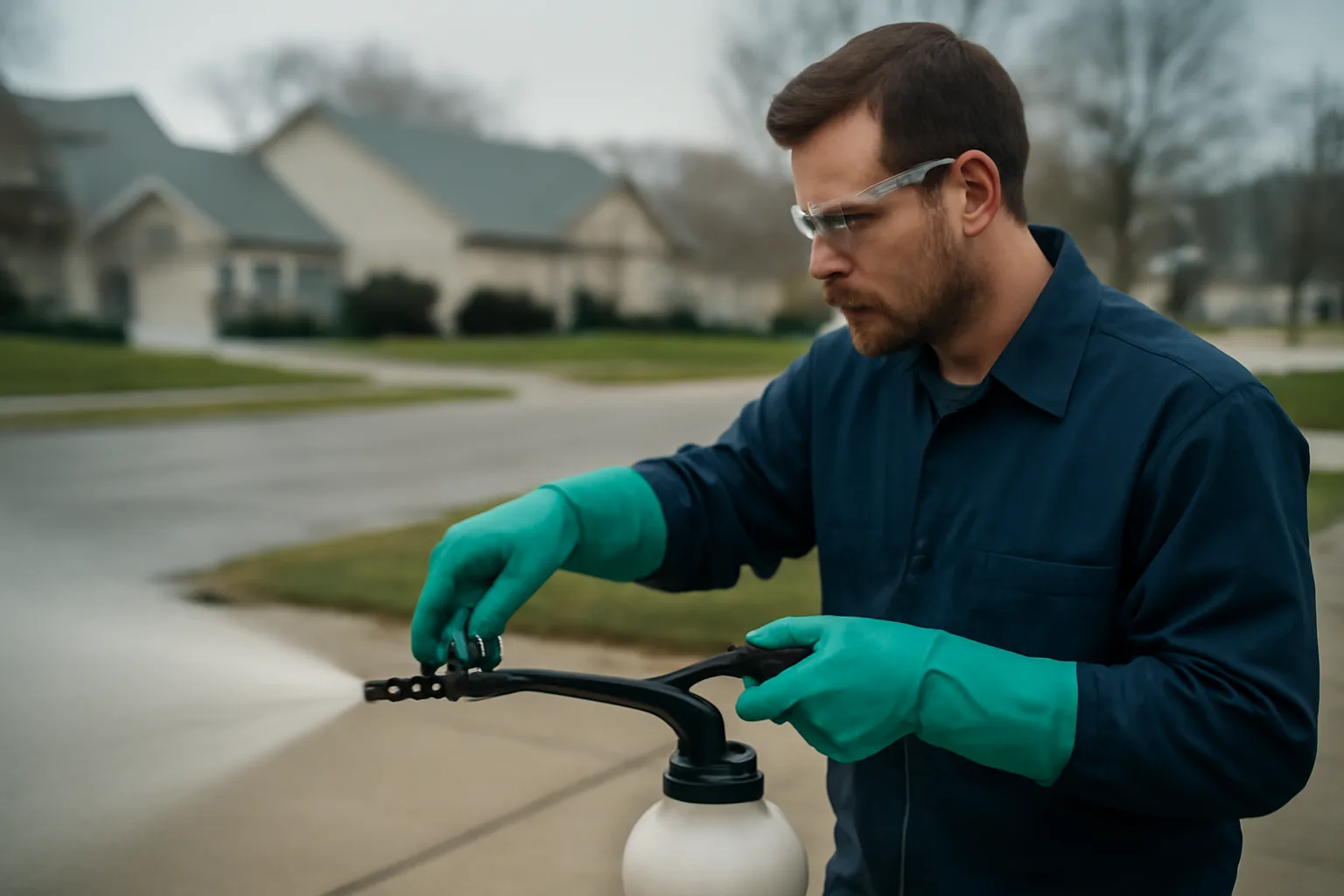
TL;DR
Delaware has no dedicated "soft wash license." To operate legally you need a registered business entity, a business license from the Division of Revenue, general liability insurance, and, if you apply any EPA-registered biocide as part of your service, a Delaware pesticide applicator license from DAPA. That last requirement catches most new operators off guard.
Do you need a license for soft wash in Delaware?
No soft wash-specific license exists in Delaware. There is no contractor board that hands out an "exterior cleaning" credential. What you actually need depends on the chemicals you spray and whether your business is registered the right way.
Here is the split that matters. If your soft wash mix is only diluted sodium hypochlorite (bleach) and a surfactant, and you make no pest-killing claim, you likely fall outside pesticide law. But the moment your marketing or your chemical label frames the treatment as killing mold, mildew, algae, or bacteria on a surface, you are applying a pesticide under Delaware law, and that triggers the applicator requirement [1].
Delaware's pesticide applicator program sits under the Delaware Department of Agriculture's Pesticides Section, known as DAPA. The governing statute is Title 3, Chapter 12 of the Delaware Code [1]. A commercial pesticide applicator license requires passing a written core exam plus a category exam. The category most relevant to soft wash operators is Category 3 (Ornamental and Turf), or possibly a right-of-way category depending on surface type. Confirm the correct category with DAPA before you register for an exam. Getting this wrong costs you exam fees and weeks of your time.
Here is the full paper checklist.
1. Register your business entity with the Delaware Division of Corporations [2]. 2. Obtain a business license from the Delaware Division of Revenue [3]. 3. Check your county or municipality for a local business license (some cities require one, some do not). 4. If you apply EPA-registered biocides for hire, get a DAPA commercial pesticide applicator license [1]. 5. Carry general liability insurance. Most residential customers and every commercial property manager will ask for a certificate.
What is the Delaware pesticide applicator license and does soft wash trigger it?
The Delaware Pesticides Section issues two tiers of credential: a registered pesticide applicator (the person doing the work) and a certified pesticide applicator (the person who supervises and holds the qualifying exam score) [1]. A commercial operation needs at least one certified applicator on staff.
The trigger for needing this license is applying a pesticide "for hire." Under Delaware Code Title 3, Chapter 12, a pesticide is any substance or mixture labeled, designed, or intended for preventing, destroying, repelling, or mitigating any pest [1]. Many of the biocide products used in soft wash, including EPA-registered disinfectants and algaecides, carry exactly that language on their labels.
The EPA's registered antimicrobial database is public and searchable [9]. Pull up the label for whatever product you plan to use. If the label says "kills" or "controls" algae, mold, or mildew, and you are applying it for compensation, you need the DAPA license.
Exam fees and renewal costs change. Confirm current figures directly with DAPA through the Delaware Department of Agriculture. As a rough reference point, many state pesticide applicator exams run in the $30 to $75 range per exam section, with annual or biennial renewal fees, but do not treat those numbers as Delaware-specific without verifying.
One practical note. Studying for the core pesticide exam is worth doing even if you decide you do not need the license. It covers label reading, chemical mixing math, environmental protection, and worker safety. That knowledge makes you a safer operator no matter what your regulatory status turns out to be.
How do you register a soft wash business in Delaware?
Business registration in Delaware runs through two separate agencies, and first-timers mix them up constantly.
The Delaware Division of Corporations handles entity formation: LLCs, corporations, partnerships [2]. An LLC is the common structure for a small exterior cleaning company because it separates personal assets from business liability. The filing fee for a Delaware LLC is $110 as of the Division's published schedule, though confirm the current fee before filing [2].
Separate from entity formation, every person or company doing business in Delaware must obtain a business license from the Delaware Division of Revenue [3]. This is essentially a gross receipts tax registration. The annual fee is modest (historically around $75, but verify the current figure with the Division of Revenue). Delaware imposes a gross receipts tax on most service businesses, and exterior cleaning is a service, so you file periodic gross receipts returns once you are operating.
If you work in Wilmington, Newark, or another incorporated town, check that city's code for a local business license. Some Delaware municipalities require a separate local registration. Others do not. The City of Wilmington runs its own business licensing through its License and Inspections office.
One thing Delaware does not require that many other states do: a general contractor license for exterior cleaning. You are not doing structural work, so no contractor board steps in. That is a real administrative advantage compared to states like Alabama or California, where contractor boards actively regulate exterior cleaning businesses.
What insurance does a soft wash business in Delaware need?
Delaware has no statutory minimum insurance requirement for soft wash or exterior cleaning contractors. But "no legal minimum" is not the same as "go uninsured."
General liability insurance is effectively mandatory in practice. Residential customers increasingly ask for a certificate of insurance before letting anyone touch their home, and any commercial property manager or HOA will require it as a contract condition. A typical soft wash operation carries $1 million per occurrence and $2 million aggregate general liability. Premiums for a startup under $100,000 in annual revenue generally run between $800 and $2,000 per year, though that range moves a lot by carrier and by how you describe the work.
Chemical overspray is the claim that kills soft wash businesses. If your sodium hypochlorite drifts onto a neighbor's landscaping or discolors a vehicle, a solid GL policy covers you. Some carriers write exterior cleaning policies with a chemical application endorsement. Others exclude it outright. Read the exclusions before you bind, not after a loss.
If you have employees, Delaware law requires workers' compensation coverage [5]. Operating with employees and no workers' comp policy exposes you to fines and personal liability.
For new operators sorting chemical documentation and certificate-of-insurance requirements at the same time, SoftWashPath's Chem + Dwell + Insurance Kit at /start pulls that paperwork into one package. Worth one mention because it fits here, and not worth mentioning again.
How much does soft wash cost in Delaware?
Soft wash pricing in Delaware tracks the rest of the Mid-Atlantic. Higher than the rural South. Lower than Manhattan.
For a single-family home, most Delaware operators price on the square footage of the surface being cleaned, not the home's living area. A standard house wash (all four elevations) on a 2,000-square-foot colonial in Newark or Dover typically runs $250 to $500. Larger homes, two-story facades, or heavily stained surfaces push that number up. Some operators charge a flat rate. Others charge per linear foot or per square foot of facade.
Roof soft washing carries higher liability and more chemical cost, so it runs $0.20 to $0.45 per square foot of roof surface. A 2,000-square-foot ranch roof (roughly 2,400 square feet of actual roof after pitch) might be quoted anywhere from $480 to $1,100 depending on pitch, access, and algae severity.
Driveway and flatwork soft washing runs lower per square foot, often $0.08 to $0.15, because it covers faster and carries less risk.
Those ranges are market observations, not a survey. Nobody has published a rigorous Delaware-specific pricing study. The closest usable benchmarks come from national exterior cleaning pricing surveys and regional anecdote from trade groups like the Pressure Washing Resource Association. Your local competition and your own cost structure should drive your numbers, not a range from an article.
Delaware's regional price parity sits close to the national average [6], which lines up with the mid-tier pricing you see in this market.
How long does soft wash take in Delaware?
Job duration is a question customers ask and new operators underestimate.
A standard two-story house wash on a typical Delaware colonial runs about 2 to 4 hours for a one-person crew, including setup, application, dwell time, and rinse. A two-person crew cuts that to 1.5 to 2.5 hours. The wide range comes from house size, surface condition, obstacles (decks, HVAC units, landscaping), and how much rinsing the surface needs after the dwell.
Roof soft washing takes less active time than people expect. Application is fast. The chemistry does the work. A residential roof might take 45 minutes to an hour to apply, then 15 to 30 minutes of dwell, then a gentle rinse. Total crew time is often under 2 hours for a standard ranch or cape cod roof.
Driveway cleaning is slower per square foot than house washing because you are working a single flat plane with more volume to cover, often with a pressure assist for stubborn staining.
Weather matters more in Delaware than operators from drier climates expect. Apply on a day below 50 degrees Fahrenheit and your sodium hypochlorite works slower, so you need longer dwell. High wind days raise overspray risk and should push you to reschedule or drop concentration. Delaware's climate is humid continental in the north shading into humid subtropical in the south, which means algae and mildew regrowth is fast. Customers near Wilmington will call back sooner than customers in Arizona ever would.
Do you need a pesticide license if you only use bleach and soap?
This is the question that starts the most arguments in online soft wash forums, and the honest answer is: it depends on the label of the exact product you use and how you market the service.
Sodium hypochlorite in its pure form is not a registered pesticide. Diluted bleach mixed with a surfactant, sold as a cleaning solution with no pest-control claims on the label, is not regulated as a pesticide under FIFRA (the Federal Insecticide, Fungicide, and Rodenticide Act) [4]. Bleach used as a general cleaner, and not marketed as a pesticide, does not trigger FIFRA registration or state applicator requirements.
Here is where soft wash operators get tripped up. If you apply a product that carries an EPA registration number on its label, and that label makes algaecide, fungicide, or mildewcide claims, you are applying a registered pesticide no matter what you personally call it. Plenty of premixed soft wash concentrates sold by suppliers carry exactly that registration.
Same trap on the marketing side. If your website, flyers, or verbal pitch say "we kill algae" or "we treat roof mold," you are making a pest-control claim, and regulators can treat that as pesticide application even if you believe your mix is just soap and bleach.
The safe practice is simple. Read the label of every product you use. Check whether it carries an EPA registration number. If it does, get the DAPA license. The exam is not hard, and the credential protects you if a state inspector ever shows up.
How does Delaware compare to neighboring states for soft wash licensing?
Delaware is one of the lighter regulatory environments on the East Coast for exterior cleaning. Here is how it stacks against its neighbors.
| State | Soft wash-specific license | Pesticide license if biocides used | Contractor license for exterior cleaning |
|---|---|---|---|
| Delaware | No | Yes (DAPA) | No |
| Maryland | No | Yes (MDA) | No (but some counties require it) |
| Pennsylvania | No | Yes (PDA) | No |
| New Jersey | No | Yes (NJDEP) | No general contractor req., but some township reqs |
| Virginia | No | Yes (VDACS) | Class A/B/C Contractor license may apply |
Virginia is the outlier here. The Virginia Board for Contractors takes a broad view of what counts as contracting work, which can pull in exterior cleaning businesses. Delaware and Pennsylvania are both straightforward: register your business, get the pesticide license if your chemicals require it, carry insurance.
To see how different states handle this at the startup level, the how to start soft wash in Alaska guide and the soft wash license in Arizona article both cover states with very different rules.
What does the DAPA pesticide applicator exam cover?
The Delaware pesticide applicator certification follows the national model built through USDA and Extension cooperation. It has a core exam (taken by everyone) and a category-specific exam [1][7].
The core exam covers pesticide law and regulation, label and labeling requirements, safety and personal protective equipment, environmental protection, application equipment, and pesticide storage and disposal. The University of Delaware Cooperative Extension offers study materials for the core exam [7].
For soft wash operators, the category exam that usually applies is Category 3 (Ornamental and Turf) if you are treating residential or commercial surfaces for algae and mildew. Some operators argue for Category 8 (Public Health) depending on the claims their service makes. Confirm the right category with DAPA before you study. Exam prep time is real, and you do not want to retake a category exam.
Exam results are typically scored the same day if the exam is proctored in person. Pass, and DAPA issues a certificate. Fail, and there is usually a waiting period before you can retest. Confirm current pass thresholds and retesting rules with DAPA directly.
The certification also makes you more credible to commercial accounts, HOAs, and facilities managers, who increasingly ask vendors to document their chemical handling qualifications.
What is the paper checklist to launch a soft wash company in Delaware?
Here is the sequence, in order, based on the state's actual requirements.
1. Choose a business name and check availability through the Delaware Division of Corporations name search [2]. 2. File your LLC or other entity with the Division of Corporations. Pay the filing fee (confirm the current amount at [2]). 3. Get a Federal Employer Identification Number (EIN) from the IRS. It is free and takes minutes online [8]. 4. Open a dedicated business bank account. 5. Obtain a Delaware business license from the Division of Revenue [3]. This registers you for gross receipts tax. 6. Check your city or county for any local business license requirement. 7. Determine whether the products you plan to use carry EPA registration numbers. If yes, register for the DAPA pesticide applicator exams [1]. 8. Study for and pass the core pesticide exam and the appropriate category exam. 9. Bind a general liability policy with a chemical application endorsement. Get a certificate of insurance. 10. If you will have employees from day one, set up workers' compensation coverage [5]. 11. Open your DAPA applicator account and make sure your license is issued before you apply any regulated product commercially.
The whole process from entity filing to being legally operational, assuming you pass the pesticide exam on the first attempt, realistically takes 4 to 8 weeks. Entity filing and EIN are fast. Exam scheduling is the variable that moves your timeline.
For the chemical documentation side of this, SoftWashPath's Chem + Dwell + Insurance Kit at /start covers SDS documentation, mix ratios, and insurance certificate templates in one package. That is the last brand mention. The rest of this guide stands on its own.
What are the ongoing compliance requirements after you launch?
Launching is not a one-time event. Delaware has annual and periodic requirements that trip up operators who set up right and then ignore the calendar.
Business license renewal: the Division of Revenue expects annual renewal of your business license [3]. They mail reminders, but the obligation is yours.
LLC annual tax: Delaware LLCs pay an annual flat franchise tax. The amount has historically been $300 per year, but confirm the current figure with the Division of Corporations [2].
Pesticide applicator license renewal: DAPA licenses run on a renewal cycle (confirm whether it is annual or biennial with DAPA directly) and typically require continuing education units or a renewal exam to keep certification current [1].
Insurance renewal: your GL policy renews annually. Review it each year, especially if your revenue grew or you added services.
Gross receipts tax filings: Delaware has no corporate income tax for most small businesses, but it does have a gross receipts tax on services. Filing frequency depends on your volume. The Division of Revenue assigns your frequency when you register [3].
Pesticide application records: if you hold a DAPA license, you may be required to keep application records including the product used, rate, date, location, and applicator name. Check the specific recordkeeping requirements in Title 3, Chapter 12 of the Delaware Code [1].
Frequently asked questions
Do you need a license for soft wash in Delaware?
There is no Delaware-specific soft wash license. You do need a registered business entity, a state business license from the Division of Revenue, and a commercial pesticide applicator license from DAPA if the products you use carry EPA pesticide registrations. Local business licenses may also apply depending on your municipality. The pesticide applicator requirement is the one most new operators miss.
How much does soft wash cost in Delaware?
A full house wash on a typical Delaware single-family home runs roughly $250 to $500. Roof soft washing generally runs $0.20 to $0.45 per square foot of roof surface. Driveway and flatwork cleaning runs lower, often $0.08 to $0.15 per square foot. These are market observations, not published survey data. Your pricing should reflect your costs, local competition, and the specific property.
How long does soft wash take in Delaware?
A standard house wash takes 2 to 4 hours for a one-person crew, or 1.5 to 2.5 hours for a two-person crew. Roof soft washing typically runs under 2 hours including dwell time. Cold weather below 50 degrees Fahrenheit slows the chemical reaction and extends dwell. Delaware's humid climate means algae regrowth is relatively fast, so customers often rebook within 1 to 3 years.
Does Delaware require a contractor license for exterior cleaning?
No. Delaware has no general contractor licensing board covering soft washing or pressure washing. You are not doing structural work, so no contractor license applies at the state level. This is one area where Delaware is genuinely easier than states like Virginia, which takes a broader view of what counts as contracting work.
What is DAPA and why does it matter for soft wash operators?
DAPA is the Delaware Department of Agriculture's Pesticides Section. It administers the commercial pesticide applicator licensing program under Title 3, Chapter 12 of the Delaware Code. If you apply any EPA-registered biocide or algaecide commercially, you need a DAPA commercial pesticide applicator credential. The process involves a written core exam and a category-specific exam.
Can I soft wash without a pesticide license in Delaware if I only use bleach?
Possibly, but it depends on two things: whether the specific product you use carries an EPA registration number on its label, and whether your marketing makes pest-control claims. Plain sodium hypochlorite with no pesticide label and no pest-kill marketing generally does not trigger pesticide law. But many soft wash concentrates do carry EPA registration. Read every label before you decide you do not need the license.
How much does the Delaware pesticide applicator license cost?
Exam and licensing fees change. The Delaware Department of Agriculture publishes current fee schedules. As a general reference point, many state pesticide exams run $30 to $75 per section, with separate renewal fees. Do not rely on any number in an article, including this one. Confirm current fees directly with DAPA before you register for an exam.
Do I need a business license in Delaware to run a soft wash company?
Yes. Every person or business operating in Delaware must obtain a business license from the Delaware Division of Revenue. This registers you for the state's gross receipts tax on services. Separately, you form your LLC or other entity through the Division of Corporations. Those are two different agencies with two different processes, and both steps are required.
Is Delaware insurance required for soft wash businesses?
Delaware law does not impose a specific minimum insurance requirement for soft wash contractors, but general liability insurance is effectively required in practice. Residential customers, HOAs, and commercial property managers routinely demand a certificate of insurance before allowing work. If you have employees, workers' compensation coverage is required by Delaware law. Carry at minimum $1 million per occurrence general liability.
How does Delaware's gross receipts tax affect a soft wash business?
Delaware has no traditional corporate income tax for most small businesses, but it does impose a gross receipts tax on service businesses. Once you register with the Division of Revenue, you file periodic gross receipts returns and pay a percentage of your service revenue. Filing frequency is assigned based on your expected revenue. This is a recurring obligation, not a one-time fee.
How do I find study materials for the Delaware pesticide applicator exam?
The University of Delaware Cooperative Extension publishes study resources for the pesticide applicator core exam. The USDA also produces national applicator training materials. For category-specific content, DAPA can point you to approved materials. Plan on at least a few weeks of study before sitting the exam, especially the core section, which covers law, label reading, and environmental protection.
How often do I need to renew my Delaware pesticide applicator license?
Renewal cycles and continuing education requirements are set by DAPA and can change. Confirm the current renewal period and any CEU requirements directly with the Delaware Department of Agriculture's Pesticides Section. Missing a renewal means you cannot legally apply registered pesticides commercially until the license is reinstated, which can create gaps in service during the busy season.
What Delaware category exam should a soft wash operator take?
For most residential and commercial soft washing involving algae, mold, and mildew treatment, Category 3 (Ornamental and Turf) is the most commonly applicable category. Some operators may fall under a different category depending on their services. Confirm the correct category with DAPA before you register, because sitting the wrong category exam is a waste of money and time.
How does Delaware soft wash licensing compare to nearby states?
Delaware is one of the lighter regulatory environments in the Mid-Atlantic for exterior cleaning. Like Maryland and Pennsylvania, it requires a pesticide applicator license if biocides are used, but no contractor license for the work itself. Virginia is notably stricter because its contractor licensing board can pull in exterior cleaning businesses. Delaware does not require a contractor license at the state level.
Sources
- Delaware Department of Agriculture, Pesticides Section (Title 3, Chapter 12, Delaware Code): Delaware's commercial pesticide applicator licensing program and the statutory definition of pesticide under Delaware law
- Delaware Division of Corporations, LLC formation and annual report requirements: Business entity formation process and filing fees for Delaware LLCs
- Delaware Division of Revenue, Business License and Gross Receipts Tax: Requirement that all persons doing business in Delaware obtain a business license from the Division of Revenue and file gross receipts tax returns
- U.S. EPA, Pesticide Registration under FIFRA: FIFRA triggers pesticide applicator requirements when a product carries an EPA registration number and makes pest-control claims; plain bleach used as a general cleaner is not a registered pesticide
- Delaware Department of Insurance: Delaware employers with employees are required to carry workers' compensation insurance
- U.S. Bureau of Economic Analysis, Regional Price Parities by State: Delaware's regional price parity is close to the national average, consistent with mid-tier service pricing in the region
- University of Delaware Cooperative Extension: University of Delaware Cooperative Extension publishes study materials for the Delaware pesticide applicator core exam
- IRS, Apply for an Employer Identification Number (EIN) Online: Federal EIN application is free and available online through the IRS
- U.S. EPA, Selected EPA-Registered Disinfectants: EPA maintains searchable lists of registered antimicrobial and disinfectant products; operators can look up whether a specific product carries an EPA registration number