Last updated 2026-08-18
TL;DR
Delaware has no statewide contractor license for soft washing in most cases. You register your business with the Delaware Division of Corporations, get a business license from the Division of Revenue, check county and municipal rules, carry general liability insurance, and handle your SDS-compliant chemical paperwork before your first job. Startup costs typically run $3,000 to $15,000 depending on equipment scale.
What is soft wash and why does Delaware treat it differently from pressure washing?
Soft washing uses low-pressure water, usually under 500 PSI, combined with diluted sodium hypochlorite and a surfactant to kill and remove biological growth like algae, mold, lichen, and mildew from roofs, siding, and concrete. Pressure washing blasts the same stuff off with brute force. Delaware doesn't have a single statewide licensing body for either service, but that doesn't mean you just show up with a pump and start spraying.
The distinction matters because the chemical side of soft washing brings its own compliance layer. You're working with sodium hypochlorite at concentrations typically between 3% and 12% on-site, and at those levels federal Right-to-Know rules and Delaware's own hazardous substance regulations require you to keep Safety Data Sheets on the job at all times [1]. That's not a licensing question. It's a workplace safety and liability question, and it applies from day one.
For most residential soft wash operators in Delaware, the paper path is shorter than you'd expect. No state trade license, no exam, no bond filed with a state board. What you need is a legitimate business registration, a state business license, proper insurance, and clean chemical documentation. The complexity comes from the county and city layer, which varies more than most people starting out realize.
Do you need a license for soft wash in Delaware?
Delaware does not require a statewide contractor license specifically for exterior cleaning or soft washing [2]. That puts Delaware in a small group of states where the soft wash operator isn't forced through a trade licensing exam before earning a dollar.
There are two carve-outs to understand. If your soft wash work is bundled into a broader construction or renovation contract, Delaware's contractor registration rules may apply depending on the scope. And some municipalities, including the City of Wilmington, require a local business license or home improvement contractor registration on top of the state business license. Confirm with the specific city or county office before you start marketing locally.
The Division of Professional Regulation for Delaware oversees dozens of trade licenses for electricians, plumbers, and HVAC contractors [3]. Exterior cleaning and soft washing don't appear on that list, which is the authoritative source. Confirm with the Division if you plan to add services that could cross into licensed trade territory, like gutter repair or wood restoration involving structural work.
Pesticide applicator licensing is a separate question. If you make any claim, even casually in marketing, that your soft wash treatment kills organisms or prevents regrowth, the Delaware Department of Agriculture could treat that as a pesticide application, which does require a license [4]. Most soft wash operators avoid this by describing their service as cleaning, not treatment. Confirm the specific language rules with the Delaware Department of Agriculture before you print any marketing materials.
What business registrations does Delaware actually require?
Every person operating a business in Delaware, including a one-truck soft wash operation, must register and maintain a business license with the Delaware Division of Revenue [5]. The annual license fee is modest, generally under $75 for most service businesses, but you renew it every year. Operating without it exposes you to back-taxes, penalties, and the inability to enforce contracts in Delaware courts.
If you form an LLC or corporation (which most operators should do for liability protection), you file that formation with the Delaware Division of Corporations, a separate agency from the Division of Revenue [6]. Delaware is one of the most popular states in the country for LLC formation because of its flexible corporate laws and the Court of Chancery. For a local soft wash business operating only in Delaware, you'll also need to register the entity as a foreign entity in any other state where you work.
Here's the paper sequence most Delaware soft wash startups follow:
1. Choose a business structure (LLC is most common for solo operators) 2. File formation documents with the Delaware Division of Corporations [6] 3. Get an EIN from the IRS (free, takes minutes at irs.gov) 4. Apply for the Delaware business license with the Division of Revenue [5] 5. Register for gross receipts tax if applicable 6. Check your county (New Castle, Kent, or Sussex) for any local permits 7. Check your municipality if you're working in incorporated towns or cities
New Castle County has its own business licensing layer. Sussex County, which covers the beach communities where soft wash demand is strong due to salt air and humidity, has different rules at the municipality level. Call the county office directly. This is the step most new operators skip, and it's the one that generates the nastiest surprise.
What insurance does a Delaware soft wash business need?
General liability insurance is not legally mandated by Delaware state law for soft wash operators the way a contractor bond might be required in other states. But in practice, no commercial property owner will let you near their building without a certificate of insurance, and most quality residential customers ask for it too. Carry at least $1 million per occurrence, $2 million aggregate. Some commercial bids require $2 million per occurrence.
Soft wash has specific insurance wrinkles that generic handyman policies often miss. Sodium hypochlorite can bleach landscaping, discolor painted trim, and damage certain roofing materials if applied incorrectly. Many general liability policies exclude damage from chemical application unless the policy is written to cover it. Read your exclusions before you buy.
If you have employees, Delaware requires workers' compensation insurance for any employee, including part-time workers [7]. The sole exception is a sole proprietor with zero employees working only for themselves. Once you hire anyone, workers' comp is mandatory and enforced by the Delaware Department of Labor.
Commercial auto insurance is separate from your personal auto policy. If you drive your truck to a job and it's registered as a business vehicle or primarily used for business, most personal auto policies won't pay out on a claim. Get a commercial auto policy that covers the vehicle, your trailer if you have one, and the equipment loaded in it.
For chemical documentation, Delaware follows federal OSHA's Hazard Communication Standard, which requires you to maintain an SDS (Safety Data Sheet) for each chemical product you use and make those sheets available to employees and, in some circumstances, customers or emergency responders [1]. This isn't insurance, but failing to have SDS documentation creates liability exposure that no insurance policy fully covers.
How much does soft wash cost in Delaware, and what does that mean for your pricing?
From the customer's perspective, soft wash pricing in Delaware runs roughly $0.20 to $0.45 per square foot for residential roof cleaning, and $0.15 to $0.35 per square foot for house washing (siding), though these numbers vary by region and condition of the surface [8]. A typical 2,000-square-foot Delaware rancher with moderate algae growth on the roof might generate an invoice between $300 and $600. A two-story colonial with heavy black streaking could run higher.
Sussex County's beach communities, places like Rehoboth Beach, Bethany Beach, and Lewes, tend to support higher prices because the salt air accelerates biological growth and homeowners there clean more frequently. Repeat customers in those markets are genuinely valuable.
From the operator's side, your chemical cost for a typical residential job should run 8% to 15% of the job price if you're mixing efficiently. Sodium hypochlorite, surfactant (often marketed as a "softwash surfactant" or you can use specific low-sudsing alternatives), and water are your three consumables. Bleach at the 10-12.5% concentration sold for commercial use costs significantly less per gallon than the pool-store stuff.
| Service Type | Typical Delaware Price Range | Avg Job Size |
|---|---|---|
| Roof soft wash (residential) | $300 to $700 | 1,500 to 2,500 sq ft |
| House wash (siding) | $200 to $500 | 1,500 to 2,500 sq ft |
| Concrete / driveway | $100 to $300 | 500 to 1,000 sq ft |
| Commercial building exterior | $500 to $2,500+ | Varies |
These are market ranges, not guarantees. Your actual pricing depends on your overhead, your market, and how good you are at estimating chemical dwell time requirements.
How long does soft wash take in Delaware, and what affects the timeline?
A standard residential soft wash job, house wash plus a single-story roof on a 2,000-square-foot home, takes most operators 2 to 4 hours from setup to rinse. Two-story homes with complex rooflines or heavy biological buildup can push that to 5 or 6 hours.
Dwell time is the variable most new operators underestimate. After you apply the sodium hypochlorite mix, the solution needs to sit on the surface long enough to kill the organic material. On a cool, overcast Delaware day in October, you might need 15 to 20 minutes of dwell before rinsing. On a hot July afternoon in Dover, the solution evaporates faster and you may need to reapply. Wind is your enemy. Heat is your enemy. Neither is a reason to rush the rinse.
Sussex County coastal jobs also introduce salt residue management. If you're cleaning a home in Dewey Beach or Ocean City-adjacent Delaware, the existing salt film on the surface affects how your mix behaves and how thoroughly you need to rinse.
For scheduling purposes in your first year, assume most jobs take longer than you planned. Drive time between jobs in rural Kent and Sussex counties adds up fast. A realistic day is 2 to 3 jobs max for a solo operator, not 4 to 6.
What equipment do you actually need to start soft wash in Delaware?
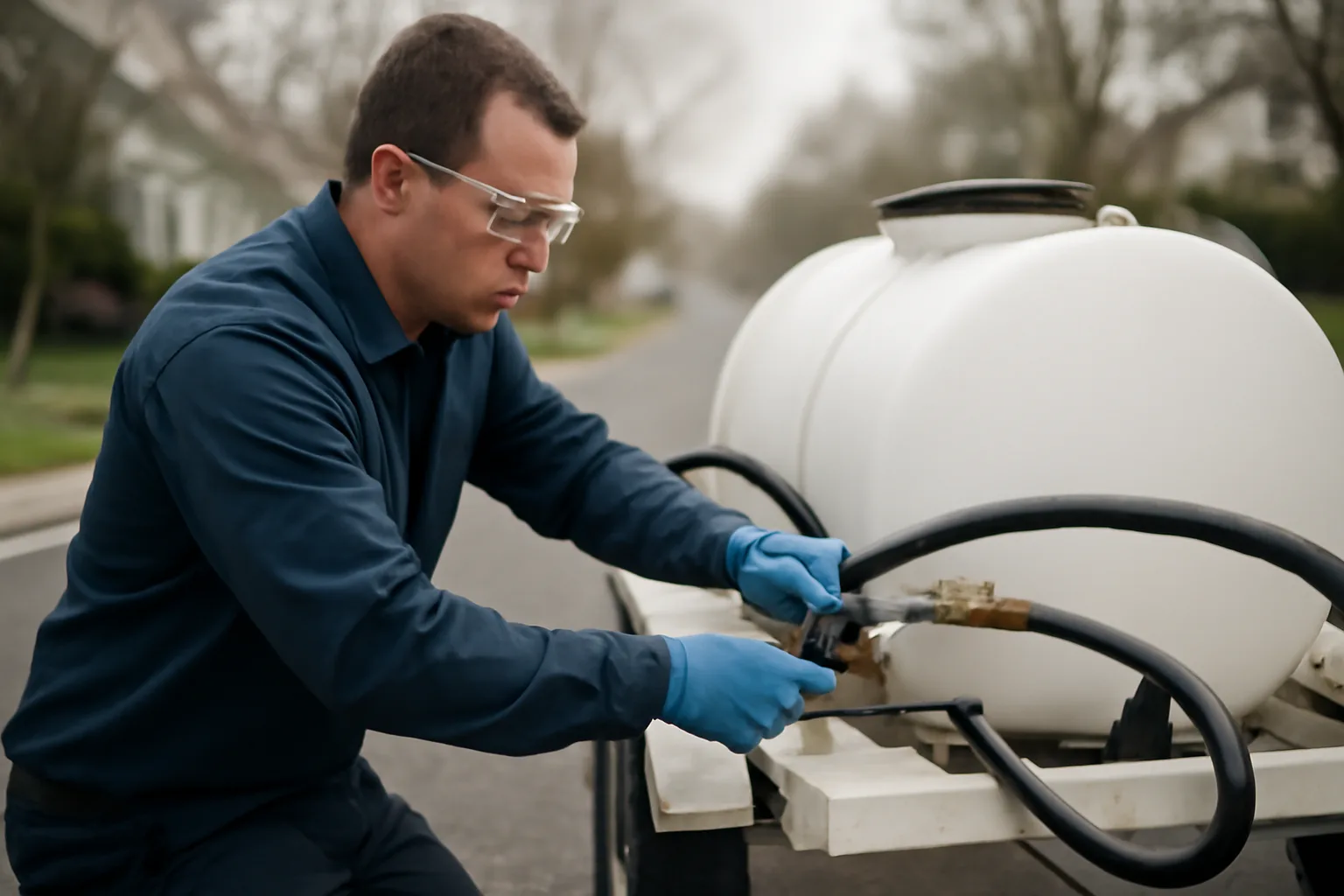
The core equipment list for a soft wash startup is shorter than the pressure washing world would have you believe. You need a 12-volt or gas-powered soft wash pump, a tank (at least 100 gallons, 200+ preferred for efficiency), hose rated for chemical use, appropriate nozzles (typically 0-degree or low-angle for soft wash application), and personal protective equipment including chemical-rated gloves, eye protection, and chemical-resistant boots.
The pump is the piece where people make expensive mistakes. A true soft wash pump delivers 5 to 7 GPM at low pressure. Trying to soft wash with a standard pressure washer turned down, a common beginner move, usually gives you uneven chemical distribution and callbacks.
A trailer setup gives you flexibility and usually makes more sense than a dedicated truck bed setup when you're starting out, because you can switch vehicles and the trailer holds a larger tank. Trailer setups for a legitimate soft wash operation run $3,000 to $8,000 built out from scratch. Buying a used trailer with existing equipment and refurbishing it is a reasonable way to cut that in half if you know what you're inspecting.
For chemical storage, Delaware's hazmat rules apply once you're holding certain quantities of sodium hypochlorite. At typical operational quantities (less than 55 gallons in transit), most operators fall under the de minimis thresholds, but confirm with the Delaware Department of Transportation if you're transporting larger amounts [9].
Laptop or tablet for estimates, invoicing software, and a basic CRM round out the real operational setup. Those cost less than a single bad callback from a bleach-damaged flower bed.
What are the chemical compliance rules for soft wash operators in Delaware?
Federal OSHA's Hazard Communication Standard (29 CFR 1910.1200) requires that any employer using hazardous chemicals, including sodium hypochlorite, maintain SDS files and train any employees on chemical hazards [1]. Even if you're solo, get in the habit of keeping SDS printouts in the truck. If an employee or a bystander has a chemical exposure incident and emergency responders ask for an SDS, you want it in your hand in 30 seconds.
Delaware also has its own Worker Right-to-Know law, codified under Delaware Code Title 16, Chapter 24, which extends hazardous substance information requirements to workers in the state [10]. It mirrors the federal standard in most respects but carries its own notification requirements for employees.
The pesticide licensing question is real, as noted earlier. Delaware Code Title 3, Chapter 12 governs pesticide use and dealer licensing in the state [4]. The Delaware Department of Agriculture has enforcement authority. If your marketing materials say your service kills mold, kills algae, or prevents regrowth, you may be making a pesticide efficacy claim. Many soft wash operators solve this by framing their service as cleaning, not treating. Get legal clarity on your specific marketing language before you launch.
Sodium hypochlorite mixed with certain common chemicals, including acids, ammonia, and some cleaning products, creates chlorine gas. This isn't a regulatory note. It's a safety one. Never mix bleach with anything other than water and your approved surfactant without knowing the chemistry.
How should you structure your first year of soft wash operations in Delaware?
Delaware is a small state geographically, about 2,489 square miles, but it has meaningful market variation. Wilmington and its suburbs in New Castle County are your densest residential population. Dover in Kent County is your mid-state base. The Sussex County coast is seasonal but high-value. A solo operator working out of a central location in Kent County can realistically reach 85% of the state's residential market in under 90 minutes of drive time.
Year one is about proving your chemical ratios, your pricing, and your scheduling before you invest in a second truck. Most operators who struggle in year one do so because they scaled too fast, hired before they had consistent revenue, and bought equipment they didn't have the job volume to support.
Price your work to cover your real costs from the first job. That means chemical cost, equipment depreciation, insurance (amortized monthly), fuel, and your own time at a rate you'd actually work for. A lot of new operators underprice their first 20 jobs trying to build reviews, then burn out because they're generating activity without generating margin.
Chemical documentation and insurance paperwork are genuinely tedious to assemble from scratch. The SoftWashPath Chem + Dwell + Insurance Kit (one-time $149 at /start) consolidates the SDS-ready templates, dwell time reference charts, and insurance coverage checklist into a single package. That's one mention because it's directly relevant here, not because this article is a sales page. The underlying information exists in your state's code and in OSHA's published standards whether or not you use any kit.
For comparison on how other low-regulation states handle the soft wash startup path, the how to start soft wash in Alabama guide and the how to start soft wash in Colorado guide are worth reading alongside this one. Delaware's light licensing environment is similar to Alabama's in some ways and different from Colorado's county-driven contractor rules.
What taxes and ongoing compliance apply to a Delaware soft wash business?
Delaware has no state sales tax. That is not a typo. It's one of the few genuine structural advantages of running a service business in Delaware, and it simplifies your invoicing considerably. You don't collect or remit sales tax on soft wash services.
You do owe gross receipts tax, which is Delaware's substitute for a sales tax and applies to businesses with revenue above certain annual thresholds. The rate for most service businesses is very low (fractions of a percent), but you must register, track revenue, and file returns with the Division of Revenue [5]. Failing to file is the most common compliance error for new small business owners in Delaware.
Federal self-employment tax applies to any net earnings you pull as a sole proprietor or LLC member. Quarterly estimated tax payments to the IRS are due in April, June, September, and January. Missing these doesn't mean you owe more tax, but it does mean you owe underpayment penalties, which add up over a full year.
Your annual Delaware business license renewal is due each year. Mark it. The Division of Revenue sends reminders, but a missed renewal can result in license lapse, which creates problems if a customer or commercial property manager runs a license verification.
Where can you get real-time answers about Delaware soft wash rules?
Rules change. Fee amounts change. Municipal requirements change when local governments update their codes. The sources in this article are accurate as of the last review date, but don't treat any article, including this one, as a substitute for calling the relevant agency directly.
For business registration and gross receipts tax: Delaware Division of Revenue, (302) 577-8200.
For entity formation (LLC, corporation): Delaware Division of Corporations, (302) 739-3073.
For pesticide applicator licensing questions: Delaware Department of Agriculture, Plant Industries Section, (302) 698-4500.
For workers' compensation requirements: Delaware Department of Labor, Division of Industrial Affairs.
For local business license requirements, call the specific county or city office for the area where you plan to work. New Castle County, Kent County, and Sussex County each have their own processes. Wilmington has its own city licensing layer on top of that.
If you're also researching how neighboring states handle this, the soft wash license in Alaska guide and soft wash license in Arizona guide give useful contrast on how different state licensing frameworks affect operators. The how to start soft wash in California guide is worth reading if you're thinking about eventually working across state lines, since California's contractor licensing requirements are among the strictest in the country and would affect any multistate expansion.
The SoftWashPath resource library at /start covers the operational documents most solo operators need in their first year, including the insurance checklist and SDS templates referenced in the chemical compliance section.
Frequently asked questions
Do you need a contractor license to soft wash in Delaware?
No. Delaware does not require a statewide contractor license for soft washing or exterior cleaning services. You need a Delaware business license from the Division of Revenue and must check local municipal or county requirements, but there is no trade exam or state contractor registration board that covers soft washing specifically. Confirm with the Division of Professional Regulation if your services expand into licensed trade territory.
Do you need a pesticide license to soft wash in Delaware?
Possibly, depending on how you market your service. Delaware Code Title 3, Chapter 12 governs pesticide applicators. If your marketing claims your treatment kills algae, mold, or prevents regrowth, the Delaware Department of Agriculture may classify that as a pesticide application, which requires a license. Most soft wash operators describe their work as cleaning only and avoid efficacy claims. Confirm your specific language with the Delaware Department of Agriculture before launching.
How much does soft wash cost in Delaware?
Residential roof soft wash in Delaware typically runs $300 to $700 for a standard 1,500 to 2,500 square foot home. House washing runs $200 to $500 for similar square footage. Sussex County beach communities often support higher pricing because salt air accelerates biological growth and cleaning frequency is higher. Concrete and driveway cleaning generally runs $100 to $300. These are market ranges, not guaranteed rates.
How long does soft wash take in Delaware?
A standard residential job, one-story house wash and roof on a 2,000-square-foot home, takes most operators 2 to 4 hours from setup to rinse. Two-story homes or heavy biological buildup push that to 5 to 6 hours. Chemical dwell time varies with temperature and humidity, which Delaware's humid summers and cool coastal conditions affect significantly. For scheduling, most solo operators handle 2 to 3 jobs per day realistically.
Does Delaware have a sales tax on soft wash services?
No. Delaware has no state sales tax, which applies to soft wash services just like every other service. You do owe gross receipts tax on business revenue above certain thresholds, which is a small percentage of gross revenue that you report to the Delaware Division of Revenue. You must register for gross receipts tax even though the rate is low. Failure to file is the most common compliance error for new operators.
What insurance does a Delaware soft wash business need?
General liability insurance is not legally mandated by Delaware state law for soft wash operators, but virtually every commercial property owner requires a certificate of insurance before allowing access. Carry at least $1 million per occurrence. If you have employees, workers' compensation insurance is mandatory under Delaware law. Commercial auto insurance is separate and required if you use a vehicle primarily for business. Confirm that your GL policy covers chemical application damage, since many don't by default.
How do I register a soft wash business in Delaware?
Form your LLC or sole proprietorship with the Delaware Division of Corporations, get a federal EIN from the IRS, then apply for a Delaware business license with the Division of Revenue. Register for gross receipts tax at the same time. Then check your specific county (New Castle, Kent, or Sussex) and municipality for any local business permits. The whole state-level process can be completed in a few days if your paperwork is clean.
What chemicals do soft wash operators use and what paperwork do they need?
The core chemistry is diluted sodium hypochlorite (bleach at 3% to 12% on-site concentration) and a surfactant. Federal OSHA's Hazard Communication Standard (29 CFR 1910.1200) requires Safety Data Sheets for each chemical kept accessible on the job. Delaware's Worker Right-to-Know law under Title 16, Chapter 24 extends these requirements to employees. Keep printed SDS sheets in your vehicle for every product you carry. This applies even if you're a solo operator.
What equipment does a soft wash startup in Delaware need?
You need a low-pressure soft wash pump (12-volt or gas, 5 to 7 GPM), a tank of at least 100 to 200 gallons, chemical-rated hose, appropriate nozzles, and full PPE including chemical-resistant gloves, eye protection, and boots. A trailer setup is more flexible than a truck bed mount and holds larger tanks. A functional built-from-scratch soft wash trailer setup costs roughly $3,000 to $8,000. Used equipment in good condition cuts that substantially.
Is there a workers' compensation requirement for soft wash businesses in Delaware?
Yes. Delaware requires workers' compensation insurance for any employee, including part-time workers. A sole proprietor with zero employees is the only exception. The Delaware Department of Labor enforces this requirement. Operating with uninsured employees exposes you to fines and personal liability for any workplace injury. Get workers' comp before your first hire, not after.
What are the best markets for soft wash in Delaware?
Sussex County's coastal communities, including Rehoboth Beach, Bethany Beach, Lewes, and Dewey Beach, have high soft wash demand because salt air and humidity accelerate algae and mold growth dramatically. Wilmington and its New Castle County suburbs have the densest residential population. Dover and central Delaware offer steady year-round residential work with less seasonal volatility than the shore. A solo operator based in Kent County can reach most of the state within 90 minutes.
Do I need a separate license to work in Wilmington vs. the rest of Delaware?
Wilmington may require a local business license or home improvement contractor registration in addition to your state-level Delaware business license. Municipal rules vary across Delaware's incorporated towns and cities. Always check directly with the city or county clerk's office for the area where you plan to work. Sussex County coastal municipalities each have their own local permit layers. This is the step most new operators skip and it's the one that generates the worst surprises.
How do soft wash startup requirements in Delaware compare to other states?
Delaware is among the lighter-regulated states for soft wash entry. It has no statewide contractor license for exterior cleaning, no state sales tax, and a straightforward business registration process. By comparison, California requires a C-61 contractor license for most exterior cleaning operations above certain dollar thresholds, and some states require a surety bond in addition to a license. Delaware's main complexity comes from local municipal licensing, not the state level.
What is the gross receipts tax for a Delaware soft wash business?
Delaware's gross receipts tax applies to most businesses once annual revenue exceeds certain thresholds. For service businesses, the rate is a fraction of a percent of gross revenue. You register with the Delaware Division of Revenue when you get your business license, file returns on a monthly or quarterly schedule depending on your revenue level, and pay the tax on gross receipts, not net profit. No sales tax is collected from customers separately.
Sources
- OSHA, Hazard Communication Standard 29 CFR 1910.1200: Federal OSHA Hazard Communication Standard requires Safety Data Sheets for hazardous chemicals including sodium hypochlorite and employee training on chemical hazards
- Delaware Division of Professional Regulation, Boards and Commissions: Delaware does not list exterior cleaning or soft washing among the licensed professions regulated by the Division of Professional Regulation
- Delaware Division of Professional Regulation, Boards and Commissions: Delaware's Division of Professional Regulation oversees licensed trade professions including electricians, plumbers, and HVAC contractors but not exterior cleaning
- Delaware Code Title 3, Chapter 12, Pesticides: Delaware Code Title 3, Chapter 12 governs pesticide use and applicator licensing and is enforced by the Delaware Department of Agriculture
- Delaware Division of Revenue: Every Delaware business must obtain and annually renew a business license from the Delaware Division of Revenue and register for gross receipts tax
- Delaware Division of Corporations: LLCs and corporations are formed by filing with the Delaware Division of Corporations, a separate agency from the Division of Revenue
- Delaware Department of Labor, Division of Industrial Affairs: Delaware requires workers' compensation insurance for any employee including part-time workers; sole proprietors with zero employees are exempt
- HomeAdvisor / Angi, Pressure Washing and Soft Wash Cost Guide (national with regional data): Residential soft wash pricing ranges approximately $0.20 to $0.45 per square foot for roof cleaning and $0.15 to $0.35 per square foot for house washing nationally, with regional variation
- Delaware Department of Transportation, Hazardous Materials Transportation: Delaware hazmat transport rules apply to operators transporting sodium hypochlorite above certain quantity thresholds
- Delaware Code Title 16, Chapter 24, Hazardous Chemical Information Act: Delaware Worker Right-to-Know Act under Title 16, Chapter 24 requires employers to provide hazardous substance information to employees, mirroring and extending the federal OSHA standard