Last updated 2026-08-18
TL;DR
Starting a soft wash business in Florida means getting a local business tax receipt from your county, carrying liability insurance, and buying equipment. There is no statewide soft wash license. But if you apply chemicals to kill algae, mold, or mildew, FDACS may require a pest control operator license under Chapter 482. Startup costs run $2,000 to $10,000. Skip the pest license and you can be working in under two weeks. Get it, and plan on 2 to 3 months.
Do you need a license for soft wash in Florida?
Florida has no state soft wash or pressure washing license. The one piece of paper you need almost everywhere is a local business tax receipt, sometimes called an occupational license, from the city or county where you work. Florida Statute 205.032 gives counties and municipalities the authority to require it [1]. Fees run $25 to $400 depending on the jurisdiction, and most offices process the paperwork in under two weeks.
The bigger question is FDACS. Chapter 482 of the Florida Statutes defines "pest" to include any "undesirable or injurious plant, animal, bacterium, fungus, or virus" [2]. Soft wash a roof to remove algae, mildew, or mold and you are arguably controlling a pest with a chemical (sodium hypochlorite, plain bleach). The statute says no person may engage in pest control without a license from FDACS [2]. Plenty of contractors run without one. FDACS can still issue citations and fines.
I would not ignore this if you plan to advertise algae or mold removal. Some companies dodge the requirement by calling the work "cleaning" instead of "mold remediation." A single consumer complaint can still start an investigation. Want full compliance? Either become a certified pest control operator or subcontract that part to a licensed applicator.
How much does soft wash cost in Florida?
A legitimate soft wash startup in Florida runs $2,000 to $10,000. That covers equipment, licensing, insurance, and chemicals. The Florida Small Business Development Center puts service business startups in the state at $2,000 to $10,000 in initial capital [3]. A complete trailer rig with a 12V diaphragm pump, tank, hose reels, and a surface cleaner runs $3,000 to $8,000. Buy a used trailer and build the system yourself and you can get under $2,000.
Licensing is cheap unless you chase the FDACS pest control license. A local business tax receipt is $25 to $400. Go the FDACS route and you pay a $150 application fee, a $100 exam fee, and a $300 initial license fee, plus the required general liability insurance (FDACS mandates a minimum $500,000 policy for pest control operators) [4]. General liability for a soft wash business without the pest control endorsement runs $500 to $1,500 per year per SCORE data on small service contractors [5].
Chemical starter costs are low. Sodium hypochlorite is cheap from pool supply stores. Surfactants and dwell guides come in a kit. SoftWashPath sells a chem and dwell kit for $149 with a surfactant concentrate and a step-by-step mixing guide, a reasonable first buy if you would rather not formulate from scratch.
All told, plan on $5,500 to $6,800 for a legitimate startup with equipment, one year of insurance, and a basic chemical supply, assuming you skip the pest license. Add the pest control operator license and you tack on roughly $600 in state fees plus higher insurance premiums.
How long does it take to start a soft wash business in Florida?
Skip the FDACS pest control license and you can be legal in a few days to two weeks. Many counties and cities issue the business tax receipt over the counter or within a week of a simple application. Once the receipt and proof of insurance are in hand, you wash the next day.
Choose the pest control operator license and the timeline stretches to 2 to 3 months. FDACS requires a two-part exam (laws and rules, plus a category exam for lawn and ornamental or structural pest control). Exam dates come around roughly once a month. After you pass, there is a background check and insurance verification. Application review takes about 30 more days [4]. Some counties also want a certificate of use or zoning approval for a home-based business, which adds a week or two.
Start the FDACS process while you build your rig and line up first clients. That way you are not sitting on idle equipment waiting for a review.
A typical soft wash house job takes 2 to 4 hours once you are running. That is a different clock than "starting," and I break down job timing in the pricing section below.
What is soft washing and why does Florida's climate make it a good business?
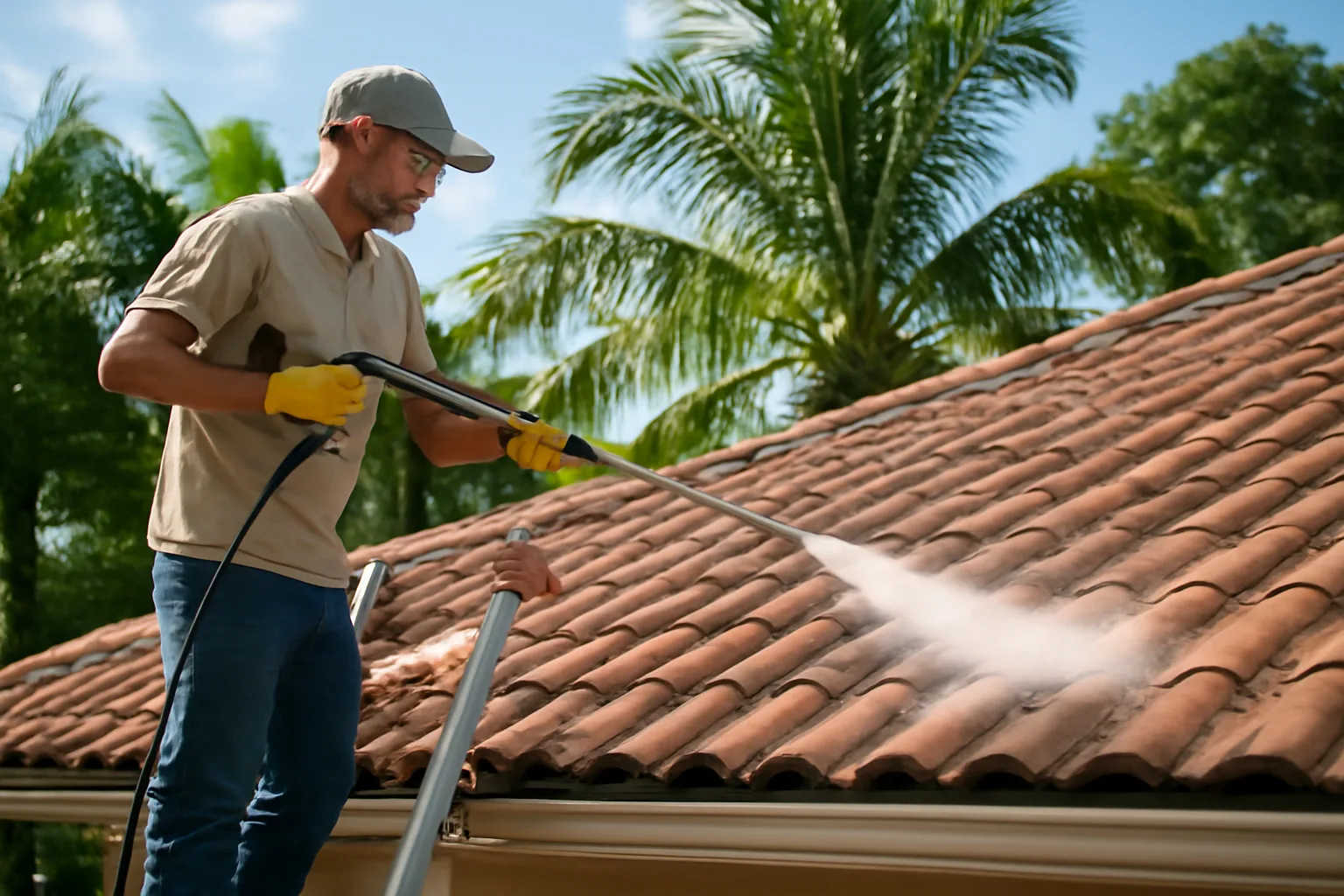
Soft washing uses low-pressure pumps, usually under 500 PSI, to apply a cleaning solution: a blend of sodium hypochlorite, water, and a surfactant. The chemistry kills the organic growth. The low pressure keeps you from tearing up shingles, tile roofs, and painted surfaces.
Florida's humidity, rain, and heat grow algae, mildew, and black streaks on nearly every exterior surface. Demand runs year-round, heaviest in coastal and suburban areas where homeowners treat staining as routine maintenance. You are not fighting seasonal shutdowns like the northern states. Florida soft wash businesses work all 12 months, which makes the initial investment easier to plan around.
Do I need a local business tax receipt in Florida?
Yes. Florida Statute Chapter 205 lets local governments require a business tax receipt for any business operating in their jurisdiction. This is not a state registration, and you do not go through the Department of Business and Professional Regulation for it. You apply directly with the city or county clerk's office.
Miami-Dade County, for example, issues a Local Business Tax Receipt after you get a certificate of use and sometimes a zoning approval. Fees vary a lot: a small town might charge $25 while a city like Orlando charges around $200. If a city requires it, you need a receipt for each municipality where you work. Most soft wash contractors run on the single receipt from their home jurisdiction and skip registering in every neighboring town unless a specific city enforces the rule hard.
Check whether your county wants a separate contractor's license for exterior cleaning. In most Florida counties, soft washing is not a construction trade, so no contractor's license applies. Some localities have odd rules for pressure washing that might catch you. Call the county building department to confirm. I have not found a county that explicitly regulates soft washing, but you never know, and a 10-minute call beats a fine.
Does FDACS require a pest control license for soft washing?
This is the murkiest part of the whole path. Chapter 482 was written for traditional pest control, but its definitions are broad enough to cover cleaning algae and mold with bleach. FDACS has issued guidance in the past that any chemical applied to kill a "pest" (fungus included) requires a license, even when the chemical is not registered as a pesticide.
Sodium hypochlorite is not regulated as a pesticide when used for sanitation. Sell a roof cleaning service that kills algae, though, and FDACS could argue you are doing pest control without a license. Enforcement is complaint-driven. A competitor or an upset homeowner can report you.
Get licensed and you become a Certified Pest Control Operator in the Lawn and Ornamental or Structural category, pass the FDACS exams, and carry the required insurance. That license also demands continuing education.
Many Florida soft wash owners find it simpler to partner with a licensed pest control operator who applies the treatment, or to word their marketing away from "killing" or "removing" mold and toward "exterior cleaning." Read the statute yourself and talk to a business attorney. The full text of 482.021 is online, as clear as it is broad. It defines "pest control" to include the use of any substance for "preventing, controlling, eradicating, identifying, mitigating, diminishing, or curtailing" pests [2].
What insurance do Florida soft wash contractors need?
The state does not mandate general liability for ordinary soft washing, but every business should carry it. Most commercial property managers want at least $1 million in coverage before they let you on-site. A policy for a small soft wash company runs $500 to $1,500 per year, per SCORE data on low-risk service contractors [5].
Carry the FDACS pest control license and the law requires a minimum of $500,000 in general liability for property damage and bodily injury [4], which pushes your premium into the $800 to $2,000 range. Workers' compensation is required in Florida if you have four or more employees, or one or more in construction. Soft washing is not classified as construction, so a solo operator skips workers' comp. Hire even one helper and the rule kicks in.
Flood and equipment floaters are worth it in hurricane country. An inland marine policy covers a trailer and gear for a few hundred dollars a year. I would not skip this if you store equipment in a shed or garage that could flood. Most contractors learn this the hard way after their first tropical storm.
What equipment and chemicals do you need to start?
A basic soft wash setup is a 12V diaphragm pump (a 7 GPM Everflo or Remco works), a 55-gallon or larger tank, 200 feet of 3/8-inch hose, a trigger gun with a tip set, and a trailer or truck bed to mount it. A turnkey rig runs $3,000 to $8,000. Many people start with a smaller portable setup under $1,500. Do not overspend on a pressure washer that claims to be a soft wash system. Those machines often cannot pull enough flow for a proper dwell time.
Chemicals are simple. Buy 12.5% sodium hypochlorite (pool shock) in bulk. Mix it 1:1 or 2:1 with water depending on how heavy the growth is. A surfactant helps the solution cling long enough to kill the algae. Soap alone does not work well. Buy surfactant concentrate and dilute it. The SoftWashPath Chem + Dwell Kit comes with a surfactant and a mixing chart for common Florida surfaces. It is no magic bullet, but it saves you the trial and error of dialing in ratios on a customer's stucco. A roof with heavy streaking may want a mild algaecide booster. Most jobs, straight SH with surfactant does it.
Personal protective equipment is mandatory: chemical-resistant gloves, eye protection, and a respirator rated for organic vapors if you work in enclosed areas or spray overhead. Florida sun means UPF clothing and plenty of water.
How do you price soft wash jobs in Florida?
A typical house pressure washing job in Florida runs $250 to $500, with soft washing often taking a 15% to 25% premium for the chemical know-how and gentler gear, per HomeAdvisor's cost data [6]. Many contractors price by linear foot or square foot: house siding $0.15 to $0.25 per sq ft, roof cleaning $0.20 to $0.35 per sq ft depending on pitch and staining. Driveways and sidewalks are usually separate at $0.10 to $0.15 per sq ft.
A single-story 1,800-square-foot home with a moderately stained roof might price at $400 to $600 for the roof clean. A full exterior wash covering house, roof, and driveway runs $800 to $1,200. Call three local soft wash companies for quotes on your own house to see what your county actually bears. Miami-Dade and a small Panhandle town will differ hard. Build a per-square-foot rate sheet, then adjust for accessibility and travel.
What are the steps to get your soft wash paperwork in order?
1. Choose a business structure and register your LLC with the Florida Division of Corporations (Sunbiz.org). The fee is $125. 2. Apply for a local business tax receipt from your county or city. Most counties take online submissions now. 3. Buy general liability insurance and get a certificate of insurance to show clients. 4. Open a business bank account and get a dedicated phone number. 5. Buy your base equipment and chemicals. Build the trailer setup or buy a turnkey rig. 6. If you decide to pursue the FDACS license, submit the application, schedule the exams, and plan on a 60-day wait. Practice on your own property in the meantime. 7. Start marketing: yard signs, Nextdoor posts, and a simple Google Business Profile are the highest-return first moves. 8. Price your first few jobs below market to build a before-and-after photo portfolio, then climb to standard rates.
This sequence works whether you are chasing a soft wash license in Alabama or setting up in any other humid state. The Florida twist is always the FDACS gray zone, and a little homework handles it.
What chemical and environmental rules apply to soft washing in Florida?
Florida has not adopted special NPDES permits for residential soft washing, but the federal Clean Water Act still applies. You cannot let wash water carrying bleach or surfactants run into storm drains, surface waters, or wetlands. On a normal house wash, the solution soaks into the ground or rinses off at low volume. Large commercial jobs may need containment or a reclaim system. The Florida Department of Environmental Protection can fine for illicit discharges.
Pre-wet and post-rinse vegetation, and use tarps to steer runoff away from drains.
If you put bleach on a roof, tell the homeowner the runoff will kill any plants it hits directly. Cover or rinse them. This is not a legal requirement. It prevents damage claims. Florida homeowners guard their landscaping, and a few dead shrubs can cost you a referral.
What are the common mistakes and how do you avoid them?
The biggest mistake I see is ignoring the FDACS pest control question because "everyone else does." A single complaint to FDACS can bring a cease-and-desist order and a fine of up to $5,000 per violation. Build a real company and you either get the license or structure your services legally.
Second mistake: underpricing roof cleans because you do not respect the chemical cost on a steep tile roof. Florida roofs often need a stronger mix and more dwell time, which eats your margin. Track chemical use per job.
Move to a state like Colorado later and the licensing path changes entirely. Our guide on how to start soft wash in Colorado shows how the rules shift.
Last one: never let a pressure washer salesman tell you high PSI beats chemistry on an asphalt shingle roof. That is how you cause thousands in damage.
Frequently asked questions
Do I need a license for soft wash in Florida?
You need a local business tax receipt from your city or county. A state soft wash license does not exist. Applying chemicals to kill algae or mold may require a pest control license from FDACS under Chapter 482. Many operators take the risk. Compliance means passing FDACS exams and carrying the designated insurance.
How much does soft wash cost in Florida?
Startup runs $2,000 to $10,000. A basic rig is $3,000 to $8,000, insurance $500 to $1,500 per year, a local tax receipt $25 to $400, and chemical starters about $150. Get the FDACS pest control license and add roughly $600 in state fees. Typical house soft wash services to customers cost $250 to $1,200 depending on scope.
How long does it take to start a soft wash business in Florida?
Without a pest license, under two weeks. With the FDACS license, 2 to 3 months for exams and approval. A single house soft wash job usually takes 2 to 4 hours for a full exterior, depending on size and staining.
Can I use bleach for soft washing in Florida legally?
Yes. Sodium hypochlorite is legal to use as a cleaning agent. The legal risk comes from marketing it as a pesticide to kill algae and mold. Clean rather than market pest control and you are less likely to trigger FDACS scrutiny. You still must prevent runoff into storm drains.
What is Florida Statute 482 for pest control?
It is the Florida Pest Control Act. It defines pest control broadly and requires a license from FDACS to apply any chemical to control pests, including fungi, algae, and mold. The text lives at the Florida Senate website under Chapter 482.021.
How much is a local business tax receipt in Miami-Dade County?
In Miami-Dade, you first need a Certificate of Use, then pay a business tax receipt fee based on your business type. For a cleaning service, expect around $200 to $400. Check the county portal for current rates, since they adjust annually.
What FDACS pest control license do I need for soft washing?
The relevant category is Lawn and Ornamental Pest Control or Structural Pest Control, depending on whether you treat turf or buildings. Most soft wash operators test for Lawn and Ornamental. You must be a Certified Operator, more than an ID cardholder.
How much does insurance for soft wash cost in Florida?
General liability for a solo soft wash contractor averages $500 to $1,500 per year. Hold a pest control license and FDACS requires at least $500,000 in coverage, which raises costs to $800 to $2,000. Shop commercial policies through an independent agent.
Is soft washing seasonal in Florida?
No. Florida's warm, humid climate grows algae year-round. Demand dips a little in the dry winter months but stays steady. You can work 12 months a year, unlike the northern states.
What equipment do I need to start a soft wash business?
A 12V diaphragm pump, a 55-gallon tank, hose, a trigger gun with chemical-resistant tips, and a trailer. A full turnkey rig costs $3,000 to $8,000. Add personal protective equipment and a surfactant.
How do I get leads for a new soft wash company in Florida?
Door hangers, a Google Business Profile with before-and-after photos, Nextdoor, and local Facebook groups work best. Offer a small discount to neighbors of a job you just finished. Word of mouth moves fast in coastal communities.
Do I need workers' comp in Florida for a soft wash business?
Not for a sole proprietor with no employees. If you have four or more employees, you must carry workers' compensation. One employee in a construction trade also triggers the requirement, but soft washing is not classified as construction.
Sources
- Florida Senate, Chapter 205, Section 032: Counties and municipalities may require a local business tax receipt for any business operating within the jurisdiction.
- Florida Senate, Chapter 482, Section 021: Defines pest to include fungus, algae, and mold; requires a license for pest control activities.
- Florida SBDC, Startup Checklist for Florida Businesses: Service business startups in Florida typically require $2,000 to $10,000 in initial capital for equipment, licensing, and operating costs.
- FDACS, Pest Control Fees and Licensing Requirements: Pest control operator initial application fee is $150, exam fee $100, initial license $300; insurance minimum $500,000.
- SCORE, How Much Does Small Business Insurance Cost?: General liability insurance for a small cleaning business runs $500 to $1,500 annually.
- HomeAdvisor, Cost to Pressure Wash a House: Typical pressure washing house cost $250-$500; soft wash services often priced at a 15-25% premium.